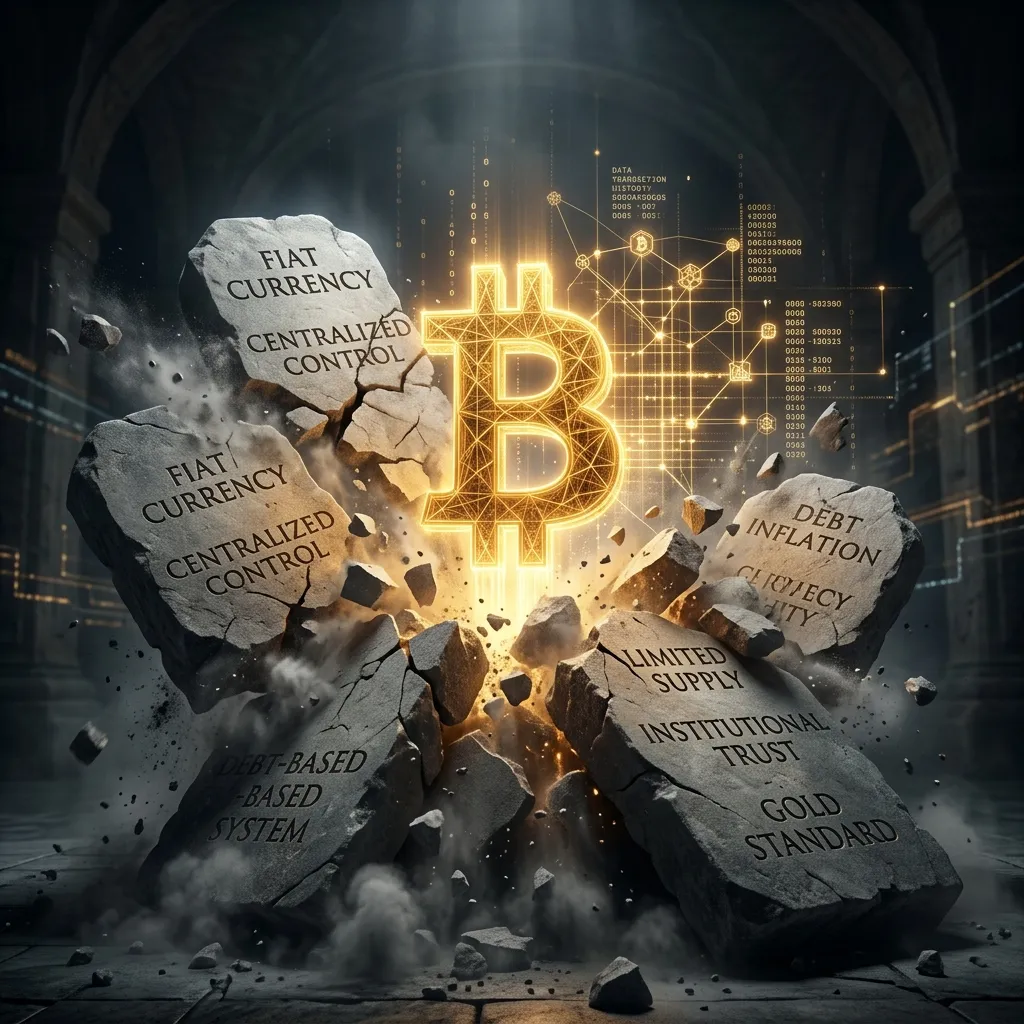
🎯 Introduction: Sifting Objective Truth from Legacy FUD
In the rapidly evolving financial landscape of 2026, FUD (Fear, Uncertainty, and Doubt) remains the primary weapon of those threatened by decentralized protocols. Most Bitcoin myths arise from a fundamental “Category Error”—applying 20th-century banking logic to a 21st-century mathematical network.
To truly understand Bitcoin today, we must move past the headlines and examine the hard on-chain data, thermodynamic realities, and game-theoretic incentives that satisfy the world’s most rigorous audits. This guide provides a definitive technical debunking of the most persistent misconceptions about the sovereign digital asset.
Section 1: Definition — What is FUD?
Why is Bitcoin the most misunderstood technology of our time?
Definition
FUD (Fear, Uncertainty, Doubt)
FUD is a psychological strategy used to influence perception by spreading negative, dubious, or demonstrably false information. In the context of Bitcoin, FUD often originates from a lack of technical understanding regarding the Difficulty Adjustment, the Lindy Effect, and the physics of Energy Arbitrage.
Bitcoin has no marketing department to defend its reputation. Its only “voice” is its open-source code and its immutable public ledger. For those who cannot read the code, the narrative is often dictated by those who profit from the status quo.
Section 2: The Core Concept — The Lindy Effect & Protocol Resilience
The longer Bitcoin survives, the more “Objective Truth” it aggregates.
Think of Bitcoin as a global, digital immune system. Every attack—whether regulatory, technical, or narrative—serves only to make the system stronger and more resilient. This is known as the Lindy Effect.
Section 3: Technical Debunking — The Data Realities
Let’s dismantle the four “Pillars of FUD” using hard engineering and economic data.
The Crime Myth
Chainalysis data proves illicit activity is <0.35% of volume. Bitcoin's 'Permanent Paper Trail' is actually a criminal's worst nightmare; it is much easier to launder cash than to move BTC under the gaze of global analytics.
The Energy Fable
Bitcoin is a 'Global Energy Scavenger'. It consumes electricity that is otherwise 'Stranded' (hydro in remote regions) or 'Flared' (methane gas). By providing a buyer for this waste, Bitcoin mining directly funds the expansion of green energy grids.
The 'Intrinsic Value' Fallacy
Utility is the source of value. Bitcoin's utility comes from absolute portability, verifiable scarcity (21M), and the inability for any government to freeze or censor your wealth. These are properties gold cannot match.
The Ponzi Misconception
Ponzis require central lies and secrecy. Bitcoin is fully transparent, open-source, and has no operator. It is a digital commodity, like oil or gold, with its price set by the global free market.
Section 4: 2026 Security Analysis — The 51% Attack
Is it possible for a billionaire or a nation-state to simply “Buy the Network”?
In 2026, the cost to perform a 51% hardware attack has crossed into the tens of billions of dollars. More importantly, the Logistics are impossible. There is not enough specialized ASIC hardware available for purchase in the world to overcome the honest mining fleet. Even if an attacker succeeded, they would “Winning” an asset that they just rendered worthless, resulting in the most expensive self-defeat in human history.
Section 5: The ‘Death Spiral’ & Difficulty Adjustment
Critics often claim that if the price drops, miners will quit, leading to a “Death Spiral” where no one processes transactions. This ignores the Difficulty Adjustment. If miners quit, the network automatically makes it easier (and thus more profitable) for the remaining miners to find blocks. Bitcoin is the only machine in the world that automatically repairs its own profitability every 2,000 blocks.
Section 6: Related Concepts — The Logic Cluster
To master the truth about Bitcoin, connect these dots:
- What is Bitcoin? → The foundational architectural reality.
- Bitcoin Mining Basics → Why energy is the anchor of truth.
- The 21 Million limit → Why inflation is technically impossible.
- Is Bitcoin Anonymous? → The reality of semi-anonymous transparency.
- The Lightning Network → Debunking the ‘Too Slow’ narrative.
Section 6: FAQ — Truth vs. Fiction
1. Is Bitcoin used mostly for illegal activities?
This is one of the most persistent myths. In reality, Bitcoin is a terrible tool for crime because every transaction is recorded on a permanent, public ledger. Chainalysis data shows that illicit use of Bitcoin is consistently under 1%, whereas physical cash remains the primary tool for global money laundering.
2. Is Bitcoin bad for the environment?
Bitcoin doesn’t “waste” energy; it consumes it to secure trillions of dollars of value. In 2026, the mining industry is a leader in renewable energy adoption. By acting as a “Buyer of Last Resort” for stranded energy (like wind or solar in remote areas), Bitcoin actually makes renewable projects more profitable.
3. Can Bitcoin be hacked?
The network has been active for over 17 years with 99.98% uptime. To “hack” the ledger, you would need to control more than 51% of the global hash rate—an feat that is physically and economically impossible for any single entity. Individual “hacks” are almost always cases of users losing their Private Keys.
4. Is Bitcoin a Ponzi scheme?
A Ponzi scheme relies on secrecy and a central operator. Bitcoin is the opposite: it is fully transparent and has no central operator. Everyone can see the code, everyone can audit the supply, and everyone can verify the transactions. It is a neutral commodity, not a financial scheme.
5. Why is Bitcoin so volatile?
Volatility is the price we pay for an asset that has Zero Inflation. In the legacy system, central banks smooth out volatility by printing more money, which destroys your purchasing power over time. Bitcoin allows the market to set the price purely based on supply and demand, which creates short-term swings but long-term growth.
Section 8: Summary — Non-Violence through Math
Mistrust of Bitcoin almost always stems from a lack of deep study. When you look past the noise, you find a network that is green, transparent, secure, and absolutely scarce. In an age of digital misinformation and monetary debasement, Bitcoin’s math is the only Objective Truth left in finance.
Don’t trust the headlines. Study the protocol. Verify the chain.