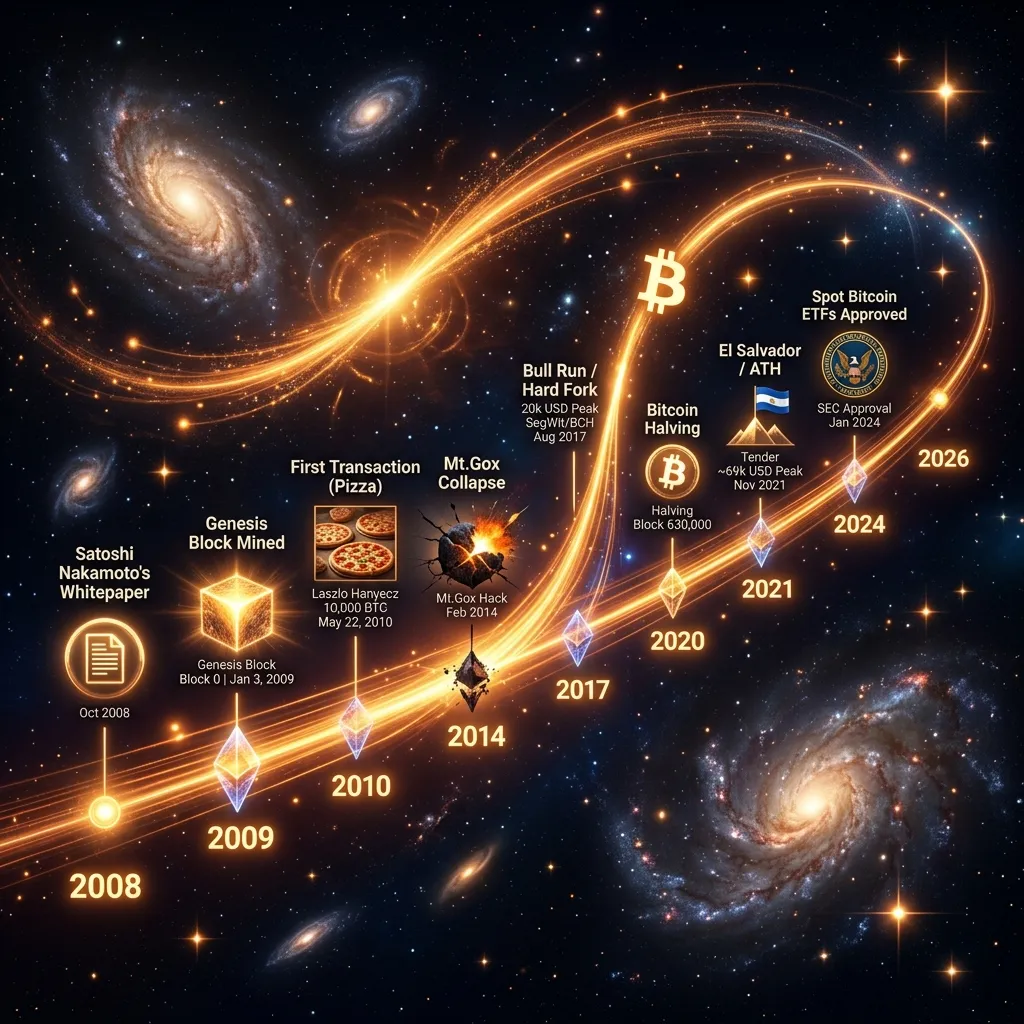
🎯 Introduction: The Sovereign Monetary Transition
As we cross the threshold of 2026, Bitcoin has transitioned from a fringe digital experiment into a multi-trillion dollar foundation for a new global financial architecture. The “if” of Bitcoin’s survival has been replaced by the “how” of its global domination.
The next decade will be defined by the transition from retail speculation to Sovereign Accumulation. In this era, Bitcoin is not just an investment; it is the fundamental infrastructure for a more transparent, predictable, and fair global economy. Understanding the technological and game-theoretic roadmap of the next ten years is essential for anyone navigating the 21st-century economic landscape.
Section 1: Definition — Hyperbitcoinization & The Soft Landing
To understand the future, we must define the ultimate end-state of the network.
Definition
Hyperbitcoinization
Hyperbitcoinization is the theoretical process by which Bitcoin evolves into the primary global unit of account and the neutral settlement layer for all international trade. In this scenario, the value of all other assets—stocks, real estate, and fiat currencies—is measured in Satoshis, removing the “political noise” and debasement risk of centralized monetary systems.
This is the “Soft Landing” for humanity: a transition from a debt-based economy of infinite expansion to a math-based economy of absolute scarcity.
Section 2: The Core Concept — The Layered Financial Pyramid
Bitcoin’s future is not a single blockchain doing everything (the “Swiss Army Knife” mistake). Instead, it is a Layered Architecture similar to the internet’s TCP/IP stack.
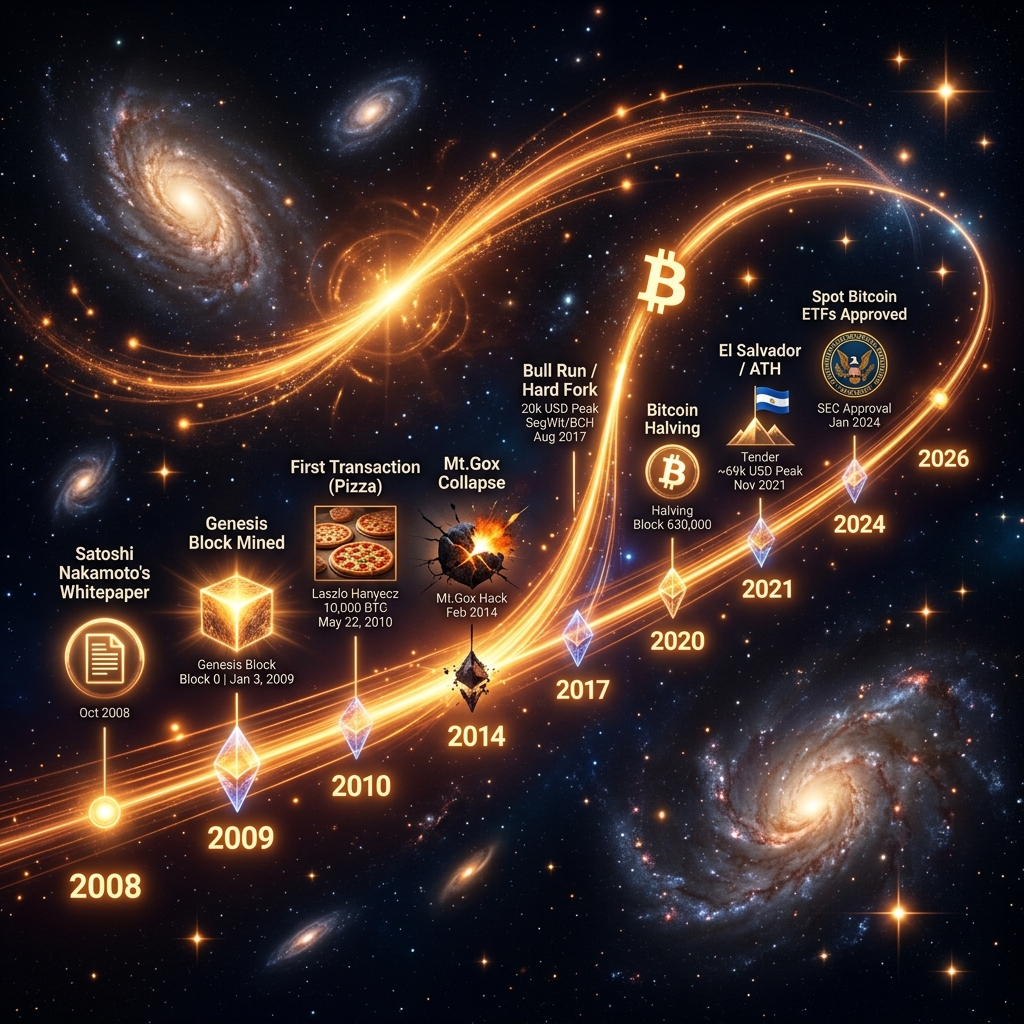
By separating Security from Speed, Bitcoin achieves what other networks cannot: it remains a “Hard Asset” at the base while allowing for billions of instant, programmable transactions at the top.
Section 3: The Roadmap — 2026 to 2035
The evolution of the network follows a predictable, code-driven path.
Institutional Maturity (2026-2027)
Multi-trillion dollar pension funds and insurance companies integrate Bitcoin into their 'Permanent 10%' portfolio weighting.
Sovereign Game Theory (2028-2029)
Following the lead of early adopters, G7 nations begin establishing 'Strategic Bitcoin Reserves' to hedge against their own currency debasement.
The BitVM Revolution (2030-2032)
Bitcoin gains 'Smart Contract' parity with Ethereum without changing its base code, enabling decentralized banking and insurance directly on BTC.
Machine-to-Machine Economy (2033-2035)
AI agents use the Lightning Network as their native language for value transfer, settleing trillions in automated 'Micro-tasks' instantly.
Section 4: 2030 Price Models & Market Capture
Where does the “Value Sponge” end? Analysts look at the total “Addressable Market.”
To estimate the long-term value of the network, analysts look at Bitcoin’s potential to capture the ‘Monetary Premium’ from traditional asset classes. If Bitcoin matures to match the market cap of Gold as a primary ‘Digital Gold’ reserve, it implies a price target of approximately $700,000 per coin. Capturing even 5% of the global real estate market’s value or 10% of the global bond market—where investors seek a risk-free asset that cannot be debased—could push the valuation well beyond $1.5 million. In a world of full institutional and sovereign adoption, the combined market capture makes a $2 million+ price per coin a mathematical possibility.
Section 5: The Intersection of AI & Bitcoin
By 2030, the largest users of the Bitcoin network will likely not be humans, but Artificial Intelligence Agents. AI agents require three things to function autonomously: Compute, Data, and Money. Bitcoin (via the Lightning Network) is the only currency that meets the requirements for AI:
- Neutrality: No bank account or ID required for an AI to hold BTC.
- Speed: Instant micro-settlement for API calls.
- Scarcity: AI requires a “Hard” unit of account to calculate the ROI of its computations.
Section 6: Related Concepts — The Evolutionary Map
The future is an expansion of the seeds planted in the first two decades:
- The 21 Million Supply Limit → The constant center of the global economy.
- The Lightning Network → Moving from thousands to billions of users.
- Bitcoin vs. Fiat Money → The final resolution of the “Great Monetary Divergence.”
- What is a Bitcoin Node? → Why running your own hardware is even more critical in a sovereign-reserve world.
- Bitcoin Mining Evolution → The transition to “Energy-Scavenging” mining.
Section 6: FAQ — The Next Decade
1. Will Bitcoin reach $1 million per coin?
While no one can predict the exact price, many analysts believe that as Bitcoin eats into the market cap of gold, real estate, and government bonds, it will reach a multi-million dollar valuation. In 2026, the question is no longer “Will it go up?” but “How fast will it demonetize other assets?“
2. What is the next big technical upgrade?
The focus has shifted toward “Covenants” and “BitVM.” These upgrades will allow users to create complex “Vaults” for institutional-grade security and even run smart contracts directly on Bitcoin, potentially making Ethereum’s complex architecture obsolete for many use cases.
3. Can governments stop the future of Bitcoin?
A global ban is practically impossible due to Game Theory. If the US or EU bans it, countries like El Salvador, Argentina, or even the UAE will simply attract the capital and talent. In 2026, governments are competing to be the most “Bitcoin-Friendly” jurisdiction to secure their economic future.
4. Will Bitcoin be used for daily purchases like coffee?
Absolutely. Through the Lightning Network, Bitcoin is already faster and cheaper than any credit card network. In the future, the complexity of Lightning will be hidden behind beautiful apps, making it as easy to use as Apple Pay but without the fees.
5. How will Bitcoin change society?
Bitcoin shifts the world toward Low Time Preference. When your money gains value over time instead of losing it to inflation, you are incentivized to save, build, and invest in the long term. This is the foundation of a more sustainable and peaceful civilization.
Section 6: FAQ — The Next Decade
1. Will Bitcoin reach $1 million per coin?
While no one can predict the exact price, many analysts believe that as Bitcoin eats into the market cap of gold, real estate, and government bonds, it will reach a multi-million dollar valuation. In 2026, the question is no longer “Will it go up?” but “How fast will it demonetize other assets?“
2. What is the next big technical upgrade?
The focus has shifted toward “Covenants” and “BitVM.” These upgrades will allow users to create complex “Vaults” for institutional-grade security and even run smart contracts directly on Bitcoin, potentially making Ethereum’s complex architecture obsolete for many use cases.
3. Can governments stop the future of Bitcoin?
A global ban is practically impossible due to Game Theory. If the US or EU bans it, countries like El Salvador, Argentina, or even the UAE will simply attract the capital and talent. In 2026, governments are competing to be the most “Bitcoin-Friendly” jurisdiction to secure their economic future.
4. Will Bitcoin be used for daily purchases like coffee?
Absolutely. Through the Lightning Network, Bitcoin is already faster and cheaper than any credit card network. In the future, the complexity of Lightning will be hidden behind beautiful apps, making it as easy to use as Apple Pay but without the fees.
5. How will Bitcoin change society?
Bitcoin shifts the world toward Low Time Preference. When your money gains value over time instead of losing it to inflation, you are incentivized to save, build, and invest in the long term. This is the foundation of a more sustainable and peaceful civilization.
Section 8: Summary — The Inevitable Architecture
The future of Bitcoin is a transition from a volatile ‘speculation’ to the global ‘infrastructure’ of truth. It is evolving into a layered financial pyramid where Layer 1 provides the ultimate security and Layer 2 provides the ultimate speed.
In a world of infinite credit and political uncertainty, Bitcoin’s finite math is the only anchor left. The future isn’t just coming; it is already written in the code.