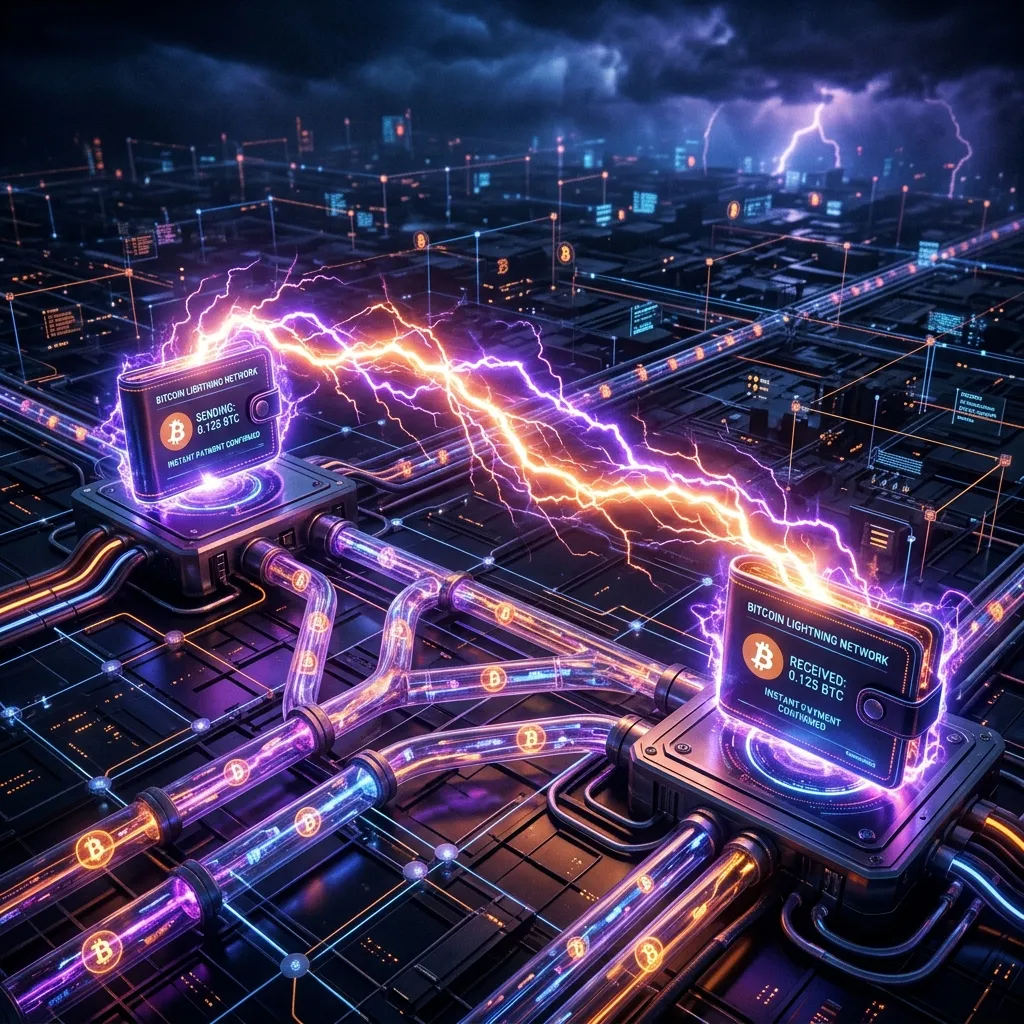
🎯 Introduction: Bitcoin’s Scaling Problem Solved
Bitcoin is the most secure and decentralized form of digital money the world has ever seen. This unmatched security comes at a price: transactions on the main blockchain can be slow and expensive. This is exactly where the Lightning Network comes in.
It is not a new cryptocurrency and not a replacement for Bitcoin, but a brilliant extension: a payment layer built on top of Bitcoin that makes transactions instant and extremely cheap.
Section 1: What is the Lightning Network?
Definition
Lightning Network
The Lightning Network is a Layer-2 payment protocol on Bitcoin that enables instant and low-cost transactions by settling payments off the blockchain. Through payment channels and cryptographic contracts, Lightning scales Bitcoin for everyday payments.
What Lightning is NOT:
- It is not its own blockchain — all transactions are ultimately secured by Bitcoin’s blockchain.
- It is not a new cryptocurrency — all payments on Lightning are exclusively in Bitcoin (BTC).
- It is not fundamentally “custodial” — users can and should retain full control over their funds.
Section 2: Why Bitcoin Needs the Lightning Network
The three central challenges for everyday Bitcoin payments:
- Limited Transaction Throughput: Only ~5–7 transactions per second. By comparison, credit card providers process thousands per second.
- High Fees Under Load: At peak demand, a single transaction can cost several dollars or more.
- Long Confirmation Times: A Bitcoin transaction is considered finally secure only after several block confirmations (10–60 minutes).
Core Insight: Bitcoin prioritizes Security & Decentralization — Lightning prioritizes Speed & Cost. Lightning solves this dilemma by enabling Bitcoin to be both: a highly secure store of value on Layer 1 and a lightning-fast payment network on Layer 2.
Section 3: How Does the Lightning Network Work?
Opening a Channel
Alice and Bob create an on-chain transaction that locks a certain amount of Bitcoin into a shared 2-of-2 multi-signature wallet. This transaction is public and requires a normal Bitcoin fee.
Off-Chain Balance Updates
Once the channel is open, Alice and Bob can send Bitcoin to each other instantly and as many times as they like. Each payment is just a signed message updating the balance — private, free, and instant.
Routing Across the Network
You don't need a direct channel with everyone. If Alice wants to pay Charlie, the payment can be routed through Bob (Alice → Bob → Charlie). Nodes find the best path automatically.
Closing a Channel
When Alice and Bob want to end their relationship, they publish the final balance with one last on-chain transaction. Funds are distributed according to the final state.
Section 4: Payment Channels & Security Mechanisms
- Multi-Signature Wallets: Channel funds are locked in a 2-of-2 multisig wallet. Any withdrawal requires the signature of both parties.
- Commitment Transactions: Each time a payment occurs within the channel, both parties create a new valid (but unsent) Bitcoin transaction reflecting the current balance.
- Revocation Keys & Penalty Mechanism: If one party tries to cheat by broadcasting an old state, the other party can claim all channel funds as a penalty. This creates a strong incentive for honesty.
Section 5: Lightning vs. On-Chain Bitcoin
| Feature | Lightning Network | Bitcoin On-Chain |
|---|---|---|
| Speed | Instant (milliseconds) | ~10–60 minutes for high security |
| Cost | Very low (often <$0.01) | Variable, can be high |
| Throughput | Very high (millions TPS theoretically) | Limited to ~7 TPS |
| Privacy | High (payments are private) | Pseudonymous (transactions are public) |
| Settlement | Off-chain (private) | On-chain (public and final) |
| Use Case | Everyday payments, micropayments | Large value transfers, cold storage |
Section 6: Security Model, Risks & Trade-offs
- Hot Wallet Risks: Unlike Bitcoin held in cold storage, Lightning channel funds must be in a “hot wallet” (connected to the internet). This carries higher risk of theft from hacks or malware.
- Routing Failures: Payments can fail due to liquidity bottlenecks. Wallets usually automatically try to find an alternative path.
- Watchtowers: Third-party services that monitor your channels while you are offline and trigger the penalty transaction if a cheating attempt is detected.
Note: For storing your savings, the Bitcoin base layer remains the gold standard. Lightning is a payment protocol, not a savings protocol.
Section 7: Real-World Use Cases
- Everyday Payments: Coffee, groceries, or online purchases — instant and nearly free.
- Micropayments & Tips: Sending a few cents as a tip for a good article — economically viable.
- Streaming Money / Value-for-Value: Podcasting 2.0 — listeners pay per minute listened, directly to creators.
- International Transfers: Seconds, a fraction of traditional service costs.
- Machine-to-Machine Payments: Electric cars paying autonomously at charging stations.
- El Salvador Case Study: The Lightning Network is the backbone of the nationwide Bitcoin adoption, enabling millions of unbanked people to participate in digital payments.
Section 8: FAQ
Is Lightning a separate cryptocurrency?
No. The Lightning Network uses only Bitcoin (BTC). It is a second layer on Bitcoin, not a separate currency.
Can Lightning scale globally?
Theoretically yes. The architecture has no inherent upper limit for transactions per second. Practical challenges lie in liquidity management and user experience, which are actively being worked on.
Section 9: Key Takeaways
- Lightning enables instant and extremely cheap Bitcoin payments.
- Payments occur in private off-chain channels; settlement takes place on the secure Bitcoin blockchain.
- Liquidity (the ability to send and receive payments) is the central resource and challenge.
- The basic security of ownership is inherited from the Bitcoin blockchain, but new trade-offs exist (e.g., hot wallet risk).
- Lightning complements Bitcoin for fast payments — it does not replace its role as a secure store of value.