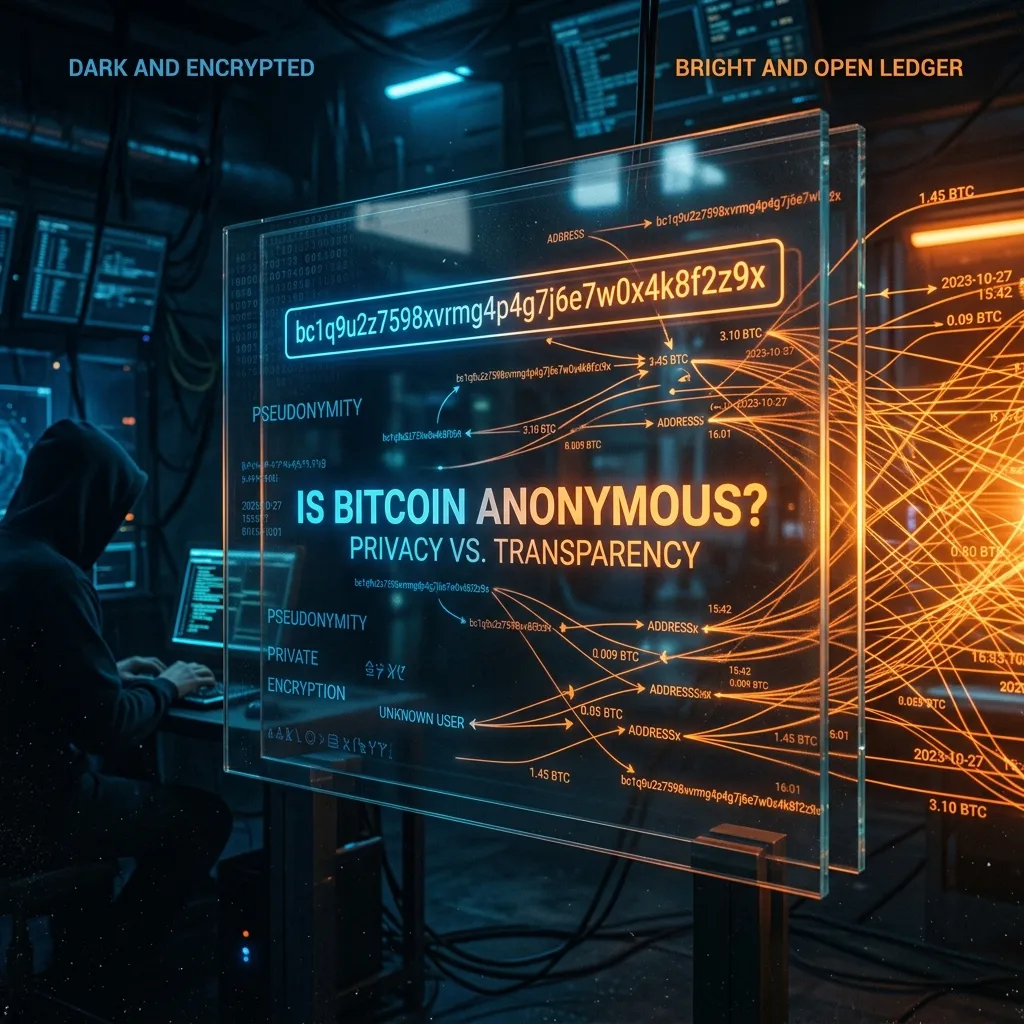
🎯 Introduction: The Transparency Trap
A common myth is that Bitcoin is “invisible” or “shadow money.” In reality, Bitcoin is the most transparent financial network ever created. While you don’t use your legal name, you use a Digital Pseudonym. This guide explains the “Glass House” nature of the blockchain, how sophisticated analytics firms track you, and how you can reclaim your digital sovereignty in an age of total surveillance.
Section 1: Definition — Pseudonymity vs. Anonymity
Understanding the difference between being invisible and wearing a digital mask.
Definition
Pseudonymity
Pseudonymity means acting under a consistent identifier that is not your legal name. On the Bitcoin blockchain, your ‘name’ is your Public Address. As long as no one can link that address to your real identity, you are private. However, once that link is made (the ‘dox’), every past and future transaction on that address is exposed to the world.
Bitcoin is not built for anonymity; it is built for Global Auditability. Everyone can verify the 21 Million Limit because everyone can see every transaction. True privacy on Bitcoin is not a default setting; it is an active choice.
Section 2: Core Concept — The Glass House Analogy
Visualizing the radical transparency of a public ledger that never forgets.
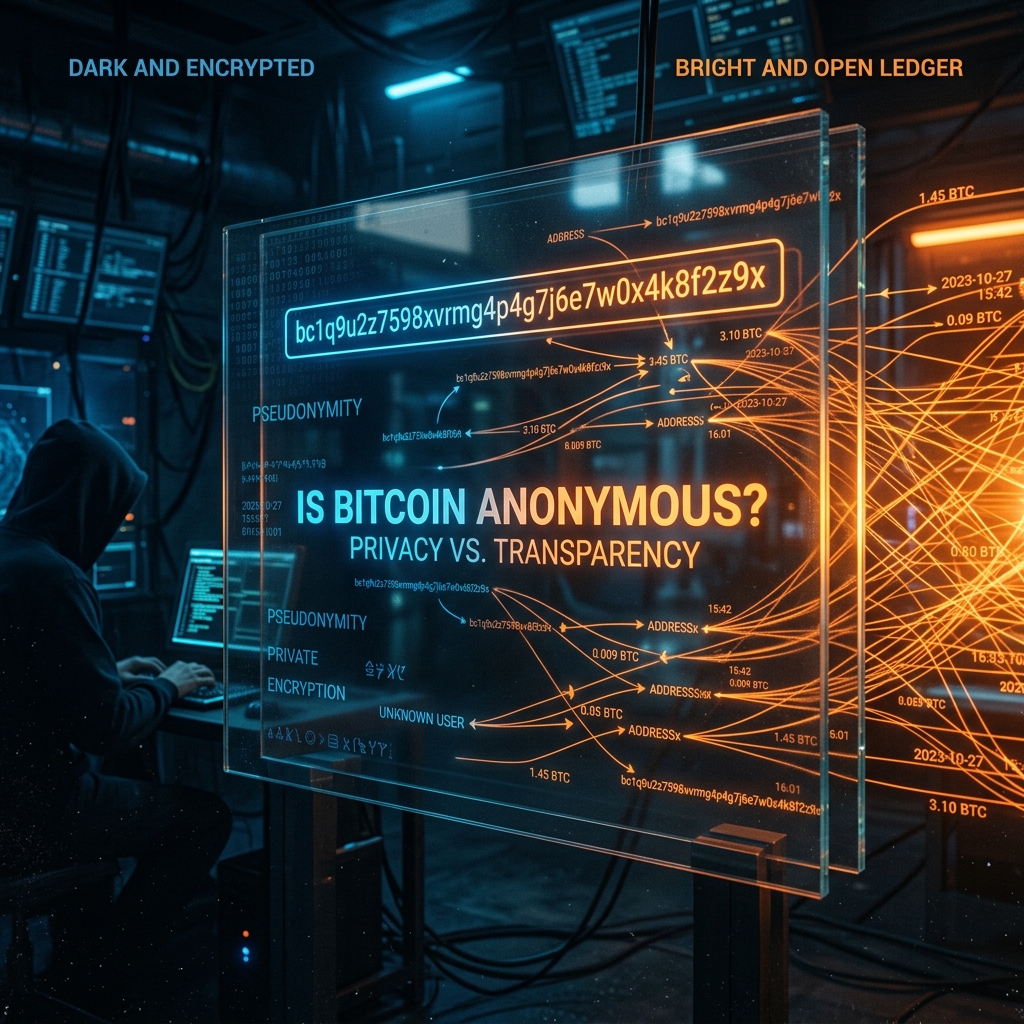
If you use Bitcoin like a traditional bank account—buying coins from a regulated exchange with your ID and shipping items to your home—you are essentially living in a glass house with the lights on.
Section 3: How It Works — The Permanent Paper Trail
Every Bitcoin transaction is linked to a previous one, going all the way back to the Genesis Block.
Heuristic Clustering
Analytics firms use mathematical patterns to figure out which addresses belong to the same wallet, even if they have different names.
Network-Level Leaks
Broadcasting a transaction without Tor or a VPN exposes your IP address to every node on the network, potentially revealing your physical location.
Section 4: Blockchain Analytics — The Corporate Eye
Companies like Chainalysis and Elliptic use “Heuristics”—rules of thumb—to peel back the layer of pseudonymity.
Corporate analytics firms utilize sophisticated heuristics to peel back the layer of pseudonymity. This includes ‘Common Input’ analysis, which assumes multiple addresses used in a single transaction belong to the same wallet, and ‘Change Analysis,’ which identifies which output address returned the remaining funds to the sender. By also performing ‘Merchant Tagging’—labeling addresses known to belong to regulated exchanges or specific services—these firms can often unmask the majority of transactions that do not employ advanced privacy-focused tools.
By combining these rules, analytics firms can often unmask 90% of transactions that aren’t using privacy-focused tools.
Section 5: Reclaiming Privacy — The Toolbox
Privacy is a muscle. If you do not exercise it, it withers. To stay private on Bitcoin, you must break the link between your identity and your coins.

Other critical tools include:
- The Lightning Network: Transfers off-chain are significantly more private as they aren’t recorded on the public ledger.
- PayJoin: A technique where you and a merchant “mix” funds during a payment, defeating the Common Input Heuristic.
- Running Your Own Node: Prevents you from leaking your wallet data to third-party servers.
Section 6: Advanced Privacy — Taproot & Silent Payments
Bitcoin’s privacy is evolving. In 2026, new protocols are making privacy easier to achieve by default.
- Taproot (MAST): Makes complex smart contracts (like Lightning channels) look like simple single-signature payments, hiding the nature of the transaction from observers.
- Silent Payments: A way to receive Bitcoin using a static public address that doesn’t reveal your history on-chain. It is like having a PO Box that automatically creates a new one for every letter.
Section 7: FAQ — Ethics, Privacy, and Law
1. Is it illegal to use privacy tools?
In most developed nations, privacy tools (like VPNs or CoinJoin) are legal. Privacy is a recognized human right (Article 12 of the UDHR). However, if these tools are used to hide the proceeds of actual crime, they can be used as evidence of money laundering intent.
2. Is Monero better than Bitcoin for privacy?
Monero is private by default, whereas Bitcoin is transparent by default. Monero provides better anonymity “out of the box,” but Bitcoin provides better Global Auditability. For many, Bitcoin’s “Opt-in” privacy is the perfect balance between transparency and freedom.
3. Will Bitcoin ever be 100% anonymous?
Bitcoin will likely remain a “Glass House” to ensure its 21 million supply limit is never broken. The goal is not to hide the money, but to hide the owner of the money.
4. Can someone see my name on a Bitcoin transaction?
No. Bitcoin transactions do not contain names, physical addresses, or ID numbers. They only contain cryptographic addresses (like bc1q...). However, if you buy Bitcoin from a regulated exchange, that company knows which address belongs to you.
5. What is a CoinJoin?
A CoinJoin is a technical process where multiple users combine their Bitcoin into a single large transaction. This makes it mathematically difficult for an observer to determine which input belongs to which output, effectively “breaking the link” of your transaction history.
Section 8: Summary — The Power to Choose
In 2026, Bitcoin remains the ultimate tool for financial freedom—but only if you know how to use it. If you use it like a traditional bank account, it will be more transparent than a bank. If you use it with Self-Custody, Tor, and CoinJoin, it becomes the most private money in human history.
Privacy is not about hiding; it is about the power to selectively reveal yourself to the world.
Explore more:
- How to run your own Node
- Understanding Public & Private Keys
- Best Bitcoin Wallets for Privacy
- Is the Lightning Network private?