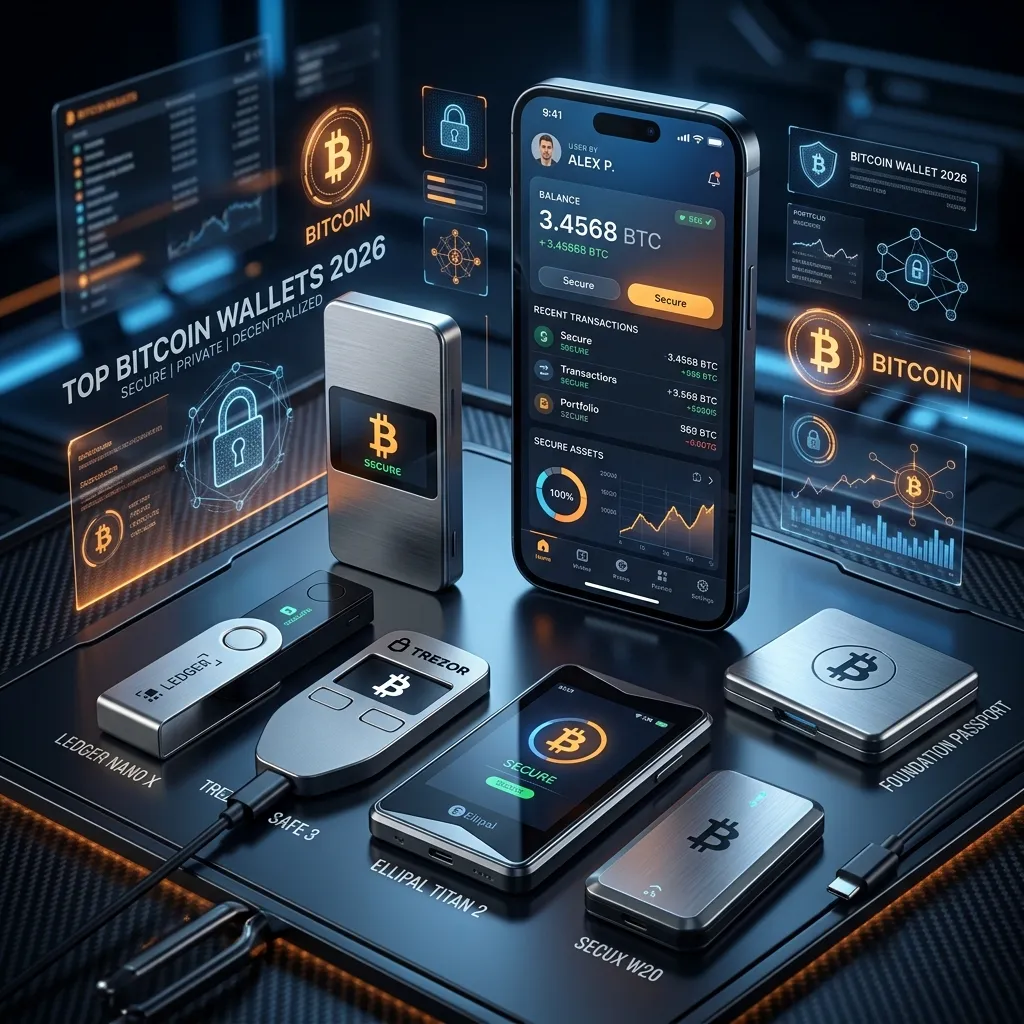
🎯 Introduction: Sovereignty in Your Pocket
In 2026, Bitcoin has matured into the world’s premier digital reserve asset. But with great value comes the absolute necessity for robust security. Unlike a traditional bank account where you are a “customer,” with Bitcoin you are the Sole Custodian.
The most critical decision any participant makes is choosing where their Private Keys live. A wallet is not merely a storage device; it is your interface for financial sovereignty. Whether you are protecting $1,000 for a trip or $1 Million for retirement, this guide will help you navigate the highly technical landscape of 2026 self-custody solutions.
Section 1: Definition — The Hierarchy of Custody
A “wallet” is a common misnomer. It doesn’t actually store Bitcoin; it stores the mathematical authorization codes (Private Keys) required to move funds on the blockchain.
Definition
Bitcoin Wallet
A Bitcoin Wallet is a software or hardware tool that manages your cryptographic keys. The gold standard in 2026 is Self-Custody, where you—and only you—possess the knowledge of these keys. The hierarchy of security ranges from “Hot Wallets” (connected to the internet) to “Cold Storage” (physically isolated hardware), ensuring that your wealth is protected according to its magnitude.
The cardinal rule of Bitcoin remains: “Not your keys, not your coins.” If you keep your funds on an exchange, you are merely a creditor to a company. With a non-custodial wallet, you are the final authority over your wealth.
Section 2: The Core Concept — Hot vs. Cold Storage
The foundation of digital security is the concept of the Air Gap—the physical isolation of your keys from the vulnerabilities of the internet.

Think of a Hot Wallet like your physical wallet—it’s convenient for daily use but dangerous to carry your entire life savings in. A Cold Wallet is your vault. In 2026, the best practice is to keep 95% of your holdings in cold storage and only 5% in a “spending” hot wallet.
Section 3: How It Works — The Lifecycle of a Key
Modern wallets use a standard called BIP-39 to turn complex binary code into something humans can manage: The Seed Phrase.
Entropy Generation
Your device generates a truly random 256-bit number (Entropy). To make this manageable, it is converted into a 12 or 24-word 'Master Seed'.
Isolated Signing
When you send BTC, the transaction is prepared on your PC/Phone but sent to the hardware device to be physically 'signed' inside a Secure Element (SE) chip.
Physical Verification
You must physically press a button on the wallet to approve the transaction. This prevents malware on your computer from draining your funds remotely.
Cryptographic Broadcast
Only the completed signature is sent back to the internet. Your Private Keys never leave the offline hardware.
Section 4: 2026 Hardware Comparison Table
The hardware market has split into two camps: General Convenience and Max-Security Performance.
The hardware wallet market in 2026 has diverged into two distinct philosophies: maximum security performance and general user convenience. Devices like the Coldcard Mk4 represent the pinnacle of security with an air-gapped MicroSD connection and dual secure elements, while the BitBox02 balances privacy and ease of use with a direct USB-C connection. For those prioritizing design and UX, the Ledger Flex offers a modern interface with certified security, whereas Trezor Safe 5 maintains full transparency through open-source secure elements. Budget-conscious users often turn to the Jade, which utilizes a unique virtual secure element and QR-code communication.
Section 5: The Master Security Block (BIP-39)
Your 24-word seed phrase is the most important thing you own. If you lose your hardware wallet, you can recreate your entire wallet on any other device using these words.

To further enhance security, many users now use a Passphrase (the 25th word). This creates a “hidden” wallet that cannot be accessed even if someone steals your 24-word seed.
Section 6: Building the Security Ecosystem
A wallet is only as strong as the network it communicates with.
- Why you need a Node → Preventing your wallet from leaking data.
- Public & Private Keys → The mathematical soul of the wallet.
- Lightning Network Guide → Instant payments for mobile ‘spending’ wallets.
- How to Store Bitcoin Safely → Physical storage and inheritance planning.
- Is my Wallet Anonymous? → Privacy trade-offs in different software.
Section 6: FAQ — Choosing Your Sovereignty Tool
1. What is the best hardware wallet in 2026?
For the majority of users, the BitBox02 and Trezor Safe 3 offer the best balance of open-source security and ease of use. If you are an advanced user who wants “Air-Gapped” security (never plugging into a computer), the Coldcard MK4 remains the gold standard.
2. Is MetaMask a good Bitcoin wallet?
No. While MetaMask is the king of Ethereum, it does not support native Bitcoin. To manage BTC, you should use wallets designed specifically for the protocol, such as Sparrow Wallet for power users or BlueWallet for mobile simplicity.
3. What is a “Watch-Only” wallet?
A Watch-Only wallet (using your xPub) allows you to see your balance and generate new receiving addresses on your phone, while your private keys stay safely inside your hardware wallet at home. It is the best way to track your wealth without risking its security.
4. Can I use my hardware wallet with my phone?
Yes. Most modern hardware wallets are now compatible with mobile devices via USB-C or Bluetooth. This allows you to sign high-security transactions from anywhere in the world without needing a laptop.
5. How do I back up my wallet?
Your hardware device is just a screen; the real “wallet” is your 12-24 word seed phrase. You must store this phrase offline. In 2026, we recommend using a Steel Seed Backup to protect your words from fire, flood, and physical decay.
Section 8: Summary — Ownership is Responsibility
In 2026, choosing a Bitcoin wallet is the first step toward true financial independence. For small amounts, a mobile wallet (Phoenix/Green) is perfect. For your life savings, a hardware wallet is a non-negotiable requirement.
Self-custody is the superpower of the 21st century. Use it wisely.