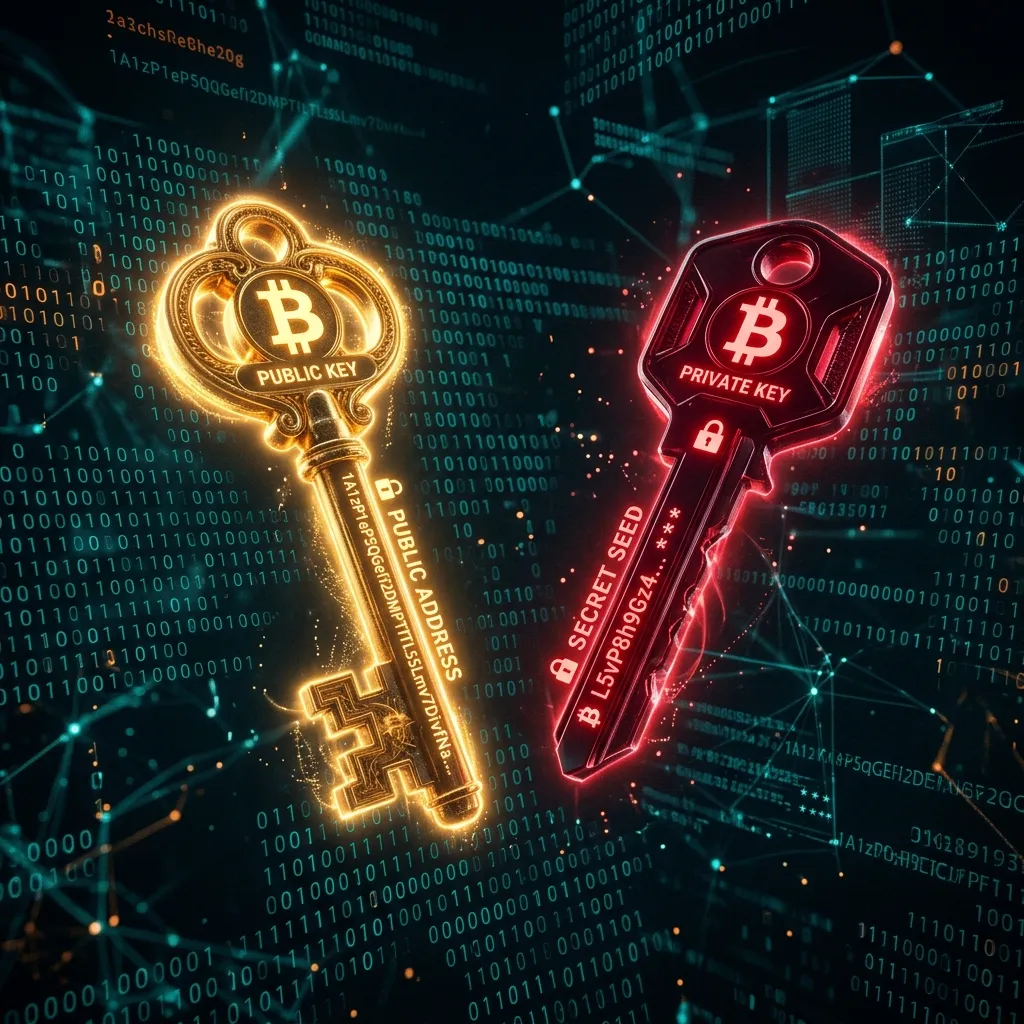
🎯 Introduction: The DNA of Digital Ownership
In the traditional world, you prove you own money by showing a government-issued ID card or logging into a bank portal. In the world of Bitcoin, ownership is proven through Mathematics. You don’t “possess” Bitcoin in the way you possess a physical gold coin; instead, you possess the cryptographic ability to move specific units of value on a public ledger.
This ability is held within your Keys. Understanding the relationship between public and private keys is not just an academic exercise—it is the fundamental requirement for protecting your digital wealth in an increasingly hostile online environment.
Section 1: Definition — The “Not Your Keys” Rule
The foundational law of the Bitcoin network is: “Not your keys, not your coins.”
Definition
Private Key
A Private Key is a secret 256-bit number that allows Bitcoin to be spent. It is generated through extreme randomness (entropy) and functions as an un-copyable digital signature. If an external party knows your private key, they effectively are the owner of your funds.
When you leave Bitcoin on an exchange (like Coinbase), they hold the keys. You are merely a creditor in their database. True financial sovereignty only begins when you take Self-Custody of your private keys using a non-custodial wallet.
Section 2: The Core Concept — The Transparent Safe
To understand the interaction between keys, visualize a high-tech mailbox system or a “Transparent Safe.”
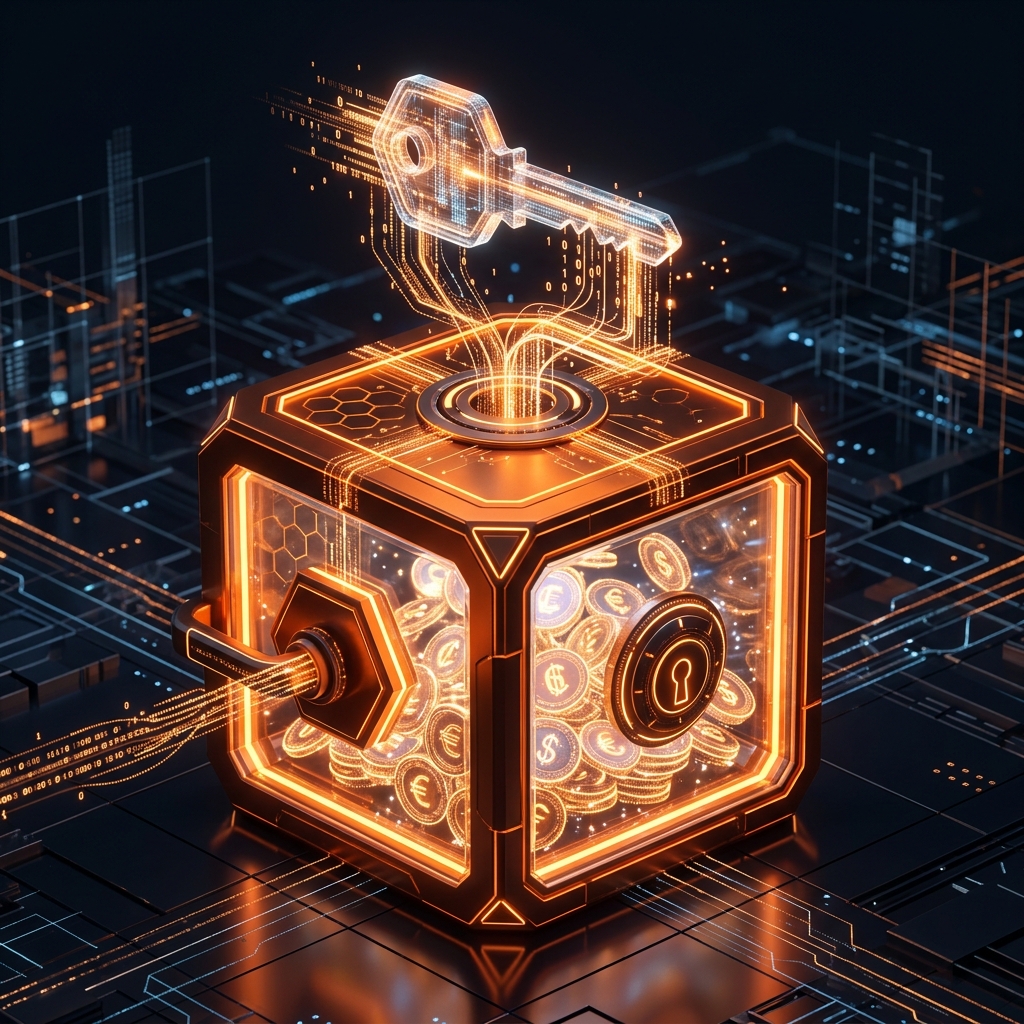
This asymmetry is what allow the Bitcoin network to be both Public (auditable by everyone) and Private (spendable only by the owner).
Section 3: How It Works — The Math of secp256k1
Bitcoin uses a specific type of math called Elliptic Curve Cryptography, specifically the secp256k1 curve. This math has a unique property: it is extremely easy to calculate in one direction, but mathematically impossible to reverse.
Entropy Generation
Your wallet picks a random number between 1 and 115 quattuordecillion. This is your Private Key.
The One-Way Trip
Your Public Key is derived from the Private Key using point multiplication on an elliptic curve. There is no mathematical way to calculate the Private Key from the Public Key.
Address Hashing
The Public Key is passed through the SHA-256 and RIPEMD-160 algorithms to create a shorter, more secure 'Bitcoin Address' for receiving funds.
Digital Signing (ECDSA)
When you spend, your Private Key creates a 'signature.' Nodes check this signature against your Public Key to verify the spend without ever seeing your Private Key.
Section 4: Human-Readable Keys — The Seed Phrase
Since a 256-bit number is impossible for a human to memorize safely, the industry uses the BIP-39 Standard.
- The Master Seed: Your 12 or 24-word Seed Phrase is a human-readable representation of your primary Private Key.
- Hierarchical Determinism (HD): This one phrase can generate an infinite number of unique addresses. You only need to back up these 24 words to secure all your assets.
[!WARNING] The Golden Rule of Security: If your seed phrase touches the internet (a photo, a text message, an email, or a cloud doc), it is compromised. Professional Bitcoiners store their seeds in Steel Plates to survive fire, floods, and time.
Section 5: Key Comparison Table (Hygiene)
Understanding the hygiene of your keys is essential for long-term security. Your Private Key is the ‘top secret’ authorization that allows you to move funds, effectively acting as your digital vault combination. In contrast, the Public Key serves as your auditable ‘ID card’ to prove ownership without revealing the secret itself. For daily use, your Address is the shareable identifier for receiving funds, similar to an IBAN. Finally, the Seed Phrase is the master recovery code—the single most important backup that can regenerate all your keys if your hardware is lost or destroyed.
Section 6: Future Considerations — Quantum and Privacy
As we move toward 2026, two topics dominate the conversation about keys:
- Quantum Resistance: While current quantum computers cannot break secp256k1, Bitcoin is already preparing upgrades to ensure your keys remain secure in a post-quantum world.
- Multisig (Multiple Keys): For large amounts, you can require 2-of-3 keys stored in different continents to authorize a spend. This eliminates the “Single Point of Failure” of a single key.
Section 7: Related Topics
Deepen your knowledge of the cryptographic fortress:
- Is Bitcoin Truly Secure? → The probability of guessing a key.
- What is a Bitcoin Node? → How the network enforces the math.
- The Best Wallets of 2026 → Where to store your keys safely.
- The Identity of Satoshi → The owner of the most famous private keys.
- History of Bitcoin → How the system was designed.
Section 8: FAQ — Clearing the Confusion
1. Can a private key be ‘guessed’ by a supercomputer?
No. There are more private key combinations than there are atoms in the observable universe. Even if you turned the entire surface of the Earth into one giant supercomputer, it would take trillions of years to guess even one active key by pure luck.
2. Is a ‘Wallet’ where my Bitcoin lives?
No. Your Bitcoin lives on the Blockchain. Your “wallet” is simply a keychain that holds the private keys required to unlock and move that value. You can lose your phone or hardware device, and as long as you have your Seed Phrase, your money is still there.
3. What is ‘Sweeping’ a key?
Sweeping is the process of taking the funds associated with a specific private key and sending them to a new address inside your main wallet. This is common when recovering funds from a paper wallet to a more secure hardware wallet.
Section 6: FAQ — Mastering Cryptographic Security
1. Can I show my public key to others?
Yes. Think of your Public Key like your IBAN or your PayPal email. Sharing it only allows people to send you money. It does not give them any ability to withdraw or see your private information.
2. What happens if someone gets my private key?
If an attacker gets your private key, your funds are gone. They can sign a transaction to move your Bitcoin to their wallet. Because Bitcoin has no “Customer Support” or “Fraud Department,” there is no way to reverse the transaction.
3. Is a seed phrase the same as a private key?
A seed phrase is a human-readable “Master Key.” Your wallet uses the seed phrase to mathematically calculate your individual private keys. Protecting your seed phrase is even more important than protecting a single private key, as it controls your entire wallet.
4. Can two people randomly generate the same private key?
The “Collision Probability” is practically zero. There are 2^256 possible private keys. To visualize this: if every person on Earth generated a billion keys per second for a trillion years, the chance of a match is still effectively zero.
5. How should I store my private key?
Never store it on a computer, phone, or cloud drive. The gold standard is to use a Hardware Wallet which keeps the key in an offline chip. Your backup should be written on paper or stamped in stainless steel and kept in a hidden, secure location.
Section 9: Summary — Be Your Own Bank
Mastering your keys is the transition from being a “consumer” to being a “sovereign.” In the traditional financial system, the bank owns the vault and gives you permission to view your balance. In Bitcoin, you are the vault. With this power comes the responsibility to protect your keys.
Knowledge is security. Ownership is freedom.