🎯 Introduction: The Anti-Fragile Odyssey
Bitcoin did not emerge from a vacuum; it was the final, elegant solution to a mathematical puzzle that had baffled cryptographers for three decades. Born as a response to a century of financial centralization and the 2008 global economic collapse, Bitcoin has transitioned from a niche digital toy into a “Sovereign Reserve Asset” held by nation-states and multi-trillion dollar funds like BlackRock.
Over the last 17 years, the network has survived internal civil wars, regulatory bans, and massive price collapses, proving its Resilience and Anti-Fragility. This is the story of how an ownerless piece of code became the hardest money in human history.
Section 1: Pre-History — The Cypherpunk Roots
While the “Genesis Block” was mined in 2009, the ideas behind Bitcoin date back to the late 1980s.
Definition
The Cypherpunks
The Cypherpunks were a loose group of technologists and activists who advocated for wide-scale use of strong cryptography and privacy-enhancing technologies as a route to social and political change. They believed that individual privacy is essential for a free society.
The history of Bitcoin is built on the shoulders of giants:
- 1997: Hashcash (Adam Back): Introduced Proof-of-Work to combat email spam.
- 1998: B-Money (Wei Dai): Described a distributed database where users solve computational puzzles to reach consensus.
- 2005: Bit Gold (Nick Szabo): Designed a system of scarce digital items linked together by proof-of-work.
The missing link in all previous attempts was a way to reach consensus without a central server. This “Byzantine Generals’ Problem” remained unsolved until Satoshi Nakamoto published the Whitepaper on October 31, 2008.
Section 2: The Core Concept — Evolution through Crisis
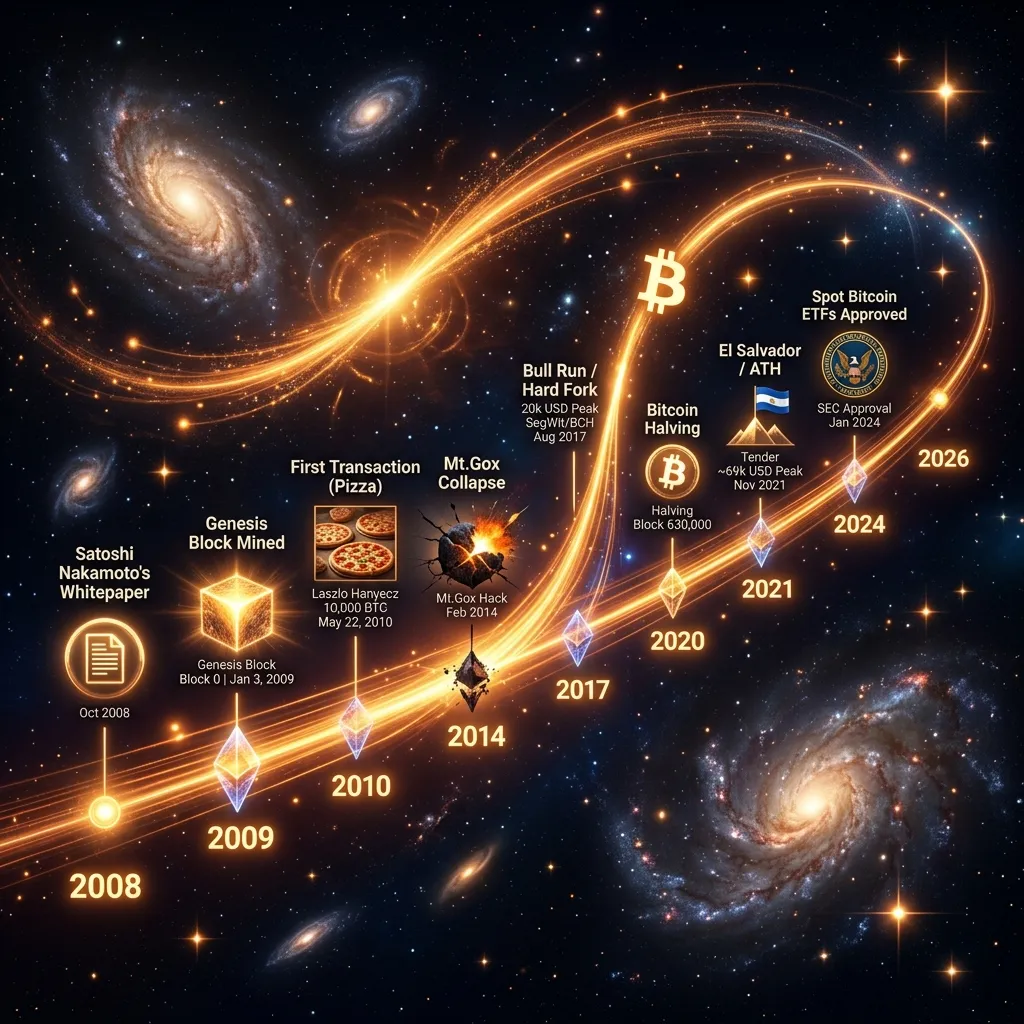
Visualizing the journey from a niche experiment to a global monetary standard.

Each time the media proclaimed “Bitcoin is dead,” the network continued to produce a block every 10 minutes, silently proving its critics wrong and growing its “Lindy Effect”—the idea that the longer something survives, the longer it is likely to persist.
Section 3: How It Evolved — The Four Epochs of Growth
The history of Bitcoin can be broken into four distinct “Epochs,” each marked by a different level of maturity and participation.
The Inception Epoch (2008–2010)
Satoshi publishes the whitepaper. The Genesis block is mined. Laszlo Hanyecz buys two pizzas for 10,000 BTC, establishing the first-ever market price for a Satoshi.
The Resilience Epoch (2011–2016)
Satoshi disappears. Mt. Gox, the world's largest exchange, collapses after a hack. Bitcoin survives an 85% crash, proving the network is independent of any single company.
The Scaling War (2017–2020)
The 'Blocksize Wars' culminate in the Bitcoin Cash fork. Node operators defeat corporate interests to keep Bitcoin decentralized. **SegWit** and **Lightning** are activated.
The Sovereign Epoch (2021–Present)
El Salvador adopts BTC as legal tender. Wall Street giants like Fidelity and BlackRock launch Spot ETFs. Bitcoin becomes a 'Strategic Reserve Asset' for corporations and states.
Section 4: Global Adoption — The Path to 1 Billion Users
Bitcoin is undergoing the fastest global adoption of any technology in human history.

Each Halving (every 4 years) has acted as a catalyst, reducing the supply of new coins and forcing the market to re-evaluate the asset’s price amidst growing global demand.
Section 5: The Defining Moment — The 2017 Fork Wars
In 2017, Bitcoin faced its greatest internal challenge: A fight over how to scale.
The defining resolution of the Fork Wars was the triumph of decentralization over raw transaction speed. While Bitcoin Cash (BCH) pushed for larger blocks that would require expensive data centers to run, the Bitcoin (BTC) community prioritized “Small Blocks” and Layer 2 scaling (Lightning). This ensured that Bitcoin remains a system where any individual can afford to run their own node and verify the rules, a victory for user sovereignty over corporate control that ultimately preserved 99% of the network’s market value.
The victory of the “Small Blockers” ensured that Bitcoin remains a system where every user can Run their own Node to check the rules.
Section 6: Related Concepts — The Historical Cluster
To truly understand Bitcoin’s place in history, you must explore its foundational pillars:
- Who is Satoshi Nakamoto? → The mystery of the creator.
- The Scaling Revolution → Why Layer 2 won the war.
- What is a Bitcoin Node? → The wächter (guards) of history.
- Understanding the Halving → The predetermined economic clock.
- Bitcoin vs Fiat Money → Why 2008 was the perfect starting point.
Section 7: FAQ — Historical Context
1. Who created Bitcoin?
Bitcoin was created by an anonymous individual or group using the pseudonym Satoshi Nakamoto. They published the whitepaper in 2008 and released the software in early 2009. Read more in our profile on Who is Satoshi Nakamoto?.
2. What was the first thing ever bought with Bitcoin?
The first commercial transaction occurred on May 22, 2010, when Laszlo Hanyecz famously paid 10,000 BTC for two Papa John’s pizzas. At the time, those coins were worth about $41. This event is celebrated annually as “Bitcoin Pizza Day.”
3. Has Bitcoin ever been hacked?
The Bitcoin protocol itself has never been successfully hacked. Its security relies on the laws of mathematics and the massive physical energy of the Mining network. However, centralized exchanges and individual wallets have been compromised due to poor security practices.
4. Why was Bitcoin created?
Satoshi Nakamoto created Bitcoin as a decentralized alternative to the traditional banking system following the 2008 financial crisis. The goal was to eliminate the need for “trusted third parties” like banks, which Satoshi believed were inherently unstable.
5. What is the “Genesis Block”?
The Genesis Block is the very first block (Block 0) of the Bitcoin blockchain, mined on January 3, 2009. It contains a hidden message referencing a newspaper headline about bank bailouts, marking the birth of a new monetary era.
Section 8: Summary — The Anti-Fragile Standard
In 2026, Bitcoin is a multi-trillion dollar network that has survived every possible stress test. It is no longer an “experiment.” Its 17-year history of 99.99% uptime and unhackable security has made it the world’s premier digital settlement layer.
History is Bitcoin’s greatest shield. Every day that it continues to function is another day it proves its critics wrong and hardens its place as the fundamental protocol of a new monetary era.