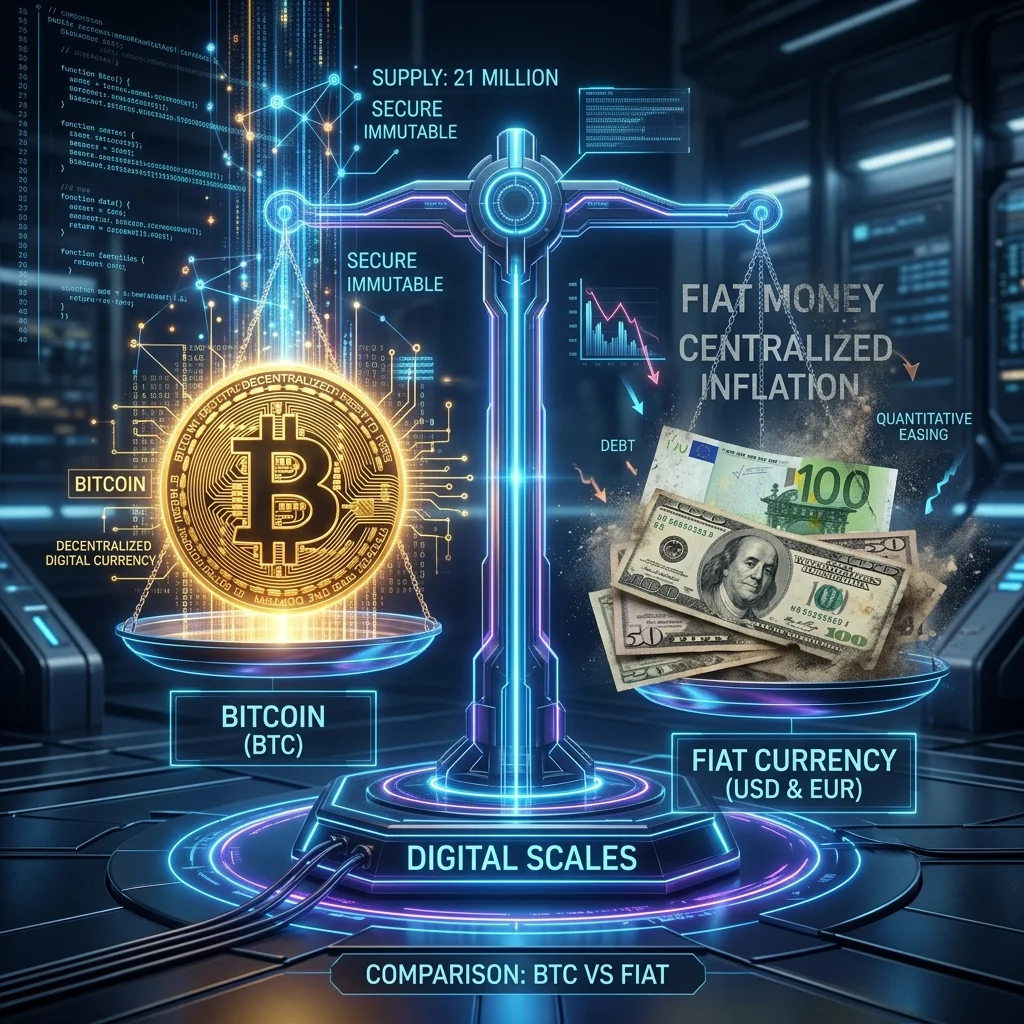
🎯 Introduction: Two Fundamental Money Philosophies
The money in your bank account and Bitcoin represent two fundamentally different ideas about how money should work. Understanding this difference is crucial — it affects the savings, salaries, and daily purchases of all of us.
Section 1: The Three Functions of Money
Before comparing Bitcoin and fiat money, let’s remember what “money” is supposed to do:
- Medium of Exchange: Something easily used to buy goods and services.
- Store of Value: Something that retains its purchasing power over time.
- Unit of Account: A common measure for pricing goods and services.
Section 2: What is Fiat Money?
Definition
Fiat Money
Fiat money is the official, government-issued currency we use daily. The term “fiat” comes from Latin meaning “by decree” — it has value only because a government declares it legal tender.
Key characteristics:
- Elastic supply: Central banks can increase or decrease the money supply at will.
- Inflation by design: Most central banks target a ~2% inflation rate.
- Enforced status: Its use is mandated by law.
Section 3: What is Bitcoin?
Definition
Bitcoin
Bitcoin is a decentralized digital monetary system with a fixed supply and no central authority. New Bitcoins are created through mining — a protocol-based process, not determined by a central bank.
Key characteristics:
- Digital Scarcity: The total supply is permanently capped at 21 million.
- Permissionless Access: Anyone with an internet connection can use Bitcoin.
- Public Ledger: Every transaction is recorded on the public blockchain.
Section 4: Core Differences — Direct Comparison
| Feature | Bitcoin | Fiat Money |
|---|---|---|
| Issuer | Protocol (algorithmic) | Central Bank |
| Supply | Fixed (21 million) | Elastic / unlimited |
| Inflation | Predictable, decreasing | Policy-driven |
| Control | Decentralized network | Centralized institutions |
| Transparency | Public ledger | Opaque bookkeeping |
| Censorship | Resistant | Possible |
Section 5: Issuance & Monetary Policy
With fiat money, central banks pursue an “elastic” monetary policy — they can print more money at will (Quantitative Easing). This leads to a gradual erosion of purchasing power over time — that’s inflation.
Bitcoin, by contrast, has a fixed and predictable monetary policy written into its code. New Bitcoins are issued at a known rate, halved approximately every four years through the Halving event. This makes Bitcoin a disinflationary system where new supply approaches zero.
Section 6: Trust & Governance Models
Fiat Money: Your trust is trust in institutions — government and central bank. The main risk is human error, political pressure, or poor decisions that devalue the currency.
Bitcoin: Your trust is trust in mathematics and open-source code. The system follows rules that are transparent and can be verified by anyone.
Key Insight: Bitcoin allows anyone, anywhere, to independently verify the entire money supply and transaction history without trusting a third party.
Section 7: Store of Value vs. Medium of Exchange
| Function | Bitcoin | Fiat Money |
|---|---|---|
| Store of Value (Long-Term) | Strong (scarcity) | Weak (inflation) |
| Medium of Exchange | Limited (on-chain) | Strong |
| Unit of Account | Weak (volatile) | Strong |
| Cross-Border Payments | Strong | Weak |
Section 8: Censorship Resistance & Financial Sovereignty
The fiat system gives authorities significant control: freeze accounts, block payments, impose capital controls.
Bitcoin is designed to be censorship-resistant. Since there is no central intermediary, no one can stop a transaction or seize your funds if you control your own private keys (self-custody).
Balanced View: This greater sovereignty comes with greater personal responsibility. If you lose your private keys, there is no customer service to call — your money is gone forever.
Section 9: Legal, Regulatory & Tax Landscape
- USA: Treated by the IRS as property, by the CFTC as a commodity.
- EU: The MiCA regulation provides a comprehensive framework for crypto-assets.
- Germany: The BaFin classifies Bitcoin as a “unit of account” and financial instrument.
Disclaimer: This content is for educational purposes only and does not constitute legal or financial advice.
Section 10: FAQ
Is Bitcoin better than fiat money?
Neither is strictly “better”; they are different tools. Fiat money is better suited for daily spending, while Bitcoin is designed as a superior long-term store of value.
What backs Bitcoin?
Bitcoin is backed by technology: cryptographic proof, a decentralized network, and the social consensus of its users based on provable scarcity.
Section 11: Key Takeaways
- The value of fiat money is based on institutional trust in governments and central banks.
- The value of Bitcoin is based on cryptographic proof and provable, digital scarcity.
- Inflation is a feature of modern fiat systems designed to encourage economic activity.
- Bitcoin introduces absolute scarcity to the digital world — a property previously only found in physical elements like gold.
- The two systems are likely to coexist for the foreseeable future.