🎯 Introduction: A New Paradigm for Money
Imagine a world where you can send any amount of money to anyone across the globe instantly, for a fraction of a cent, without asking permission from a bank or a government. This is not science fiction—it is the reality of the Bitcoin protocol.
Launched in 2009 by the anonymous Satoshi Nakamoto, Bitcoin represents the first time in human history that we have created a purely digital, decentralized, and absolutely scarce asset. It is the marriage of computer science and monetary theory.
📈 Section 1: History & Milestones
The evolution of Bitcoin has been marked by technological breakthroughs and global adoption:
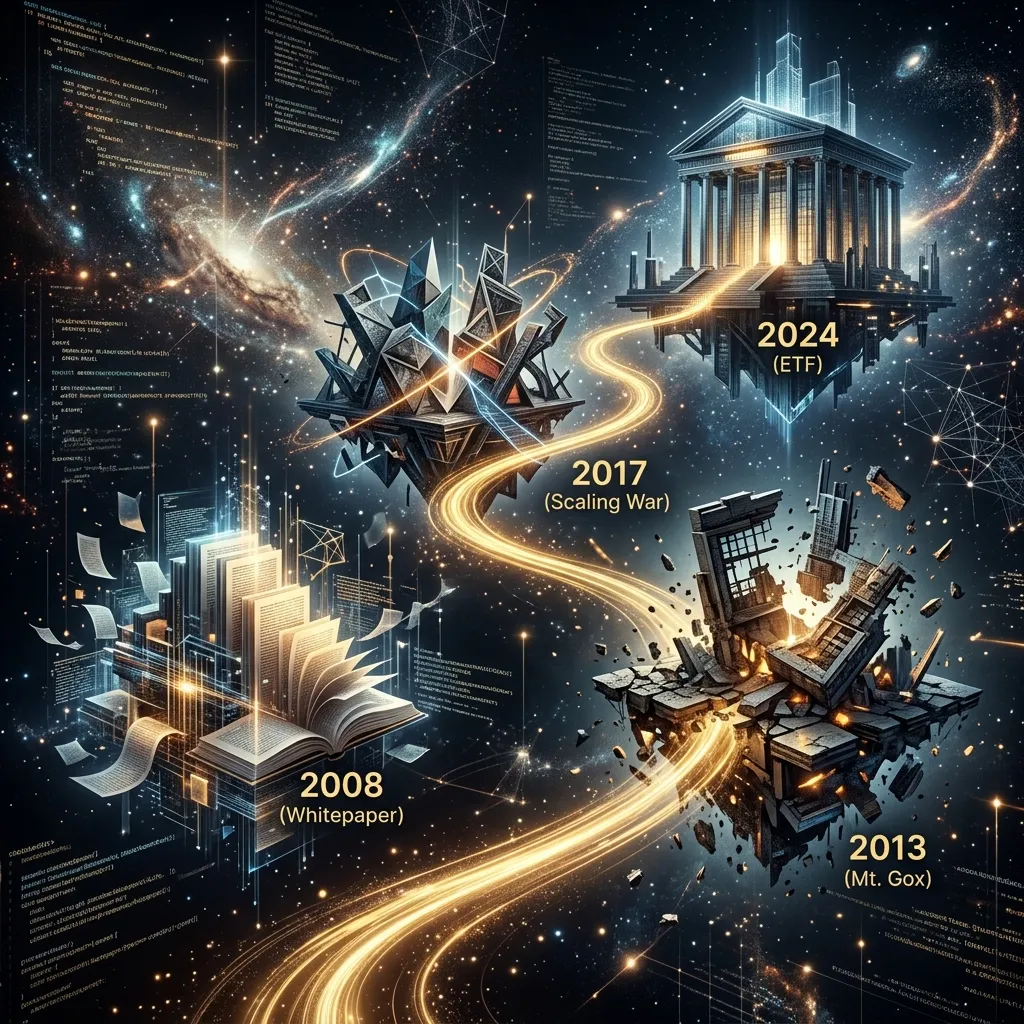
- 2010: “Bitcoin Pizza Day” – 10,000 BTC were spent for two pizzas (the first real-world transaction).
- 2021: El Salvador makes history by becoming the first country to adopt Bitcoin as legal tender.
- 2024: The approval of the first Spot Bitcoin ETFs in the US by giants like BlackRock marks the definitive entry into the Wall Street mainstream.
⚙️ Section 2: Technical Basis
At its core, Bitcoin is not “coins” or “files”; it is a digital protocol for the global transfer of value. Unlike a credit card payment which relies on a “trusted” bank to verify a balance, Bitcoin relies on the laws of mathematics and physics.
Definition
Bitcoin (BTC)
Bitcoin is a decentralized, peer-to-peer digital currency that uses a public, distributed ledger (the Blockchain) to record transactions. It is Permissionless (anyone can join), Censorship-Resistant (no one can stop a transaction), and Immutable (once recorded, it can never be changed).
Why is this revolutionary? Because for the first time, we have a financial system with no “Single Point of Failure.” There is no head office to raid, no central server to shut down, and no CEO to arrest.
The Machine of Truth
Cryptographic Signing
You use your [Private Key](/en/blog/public-private-keys/) to sign a transaction, proving ownership of funds without revealing your secret password.
Mempool Propagation
Your transaction is broadcast to thousands of independent [Nodes](/en/blog/what-is-a-bitcoin-node/) who verify it against the rules of the network.
Global Settlement
Once confirmed in a block by miners through Proof-of-Work, your transaction is permanent. It is now part of the history of the world.
💎 Section 3: The Core Concept — Absolute Digital Scarcity
The most important concept to grasp about Bitcoin is its Absolute Scarcity. Most digital items can be copied for free. Bitcoin solved the “Double Spend” problem without a central authority, creating the world’s first scarce digital object.

🛡️ Section 4: Mining & Proof of Work
The network is secured by a process called Mining. Miners provide massive computing power to solve complex mathematical puzzles, securing the history of all transactions.
- Security: An attack on the network (51% attack) is practically impossible due to the immense resources required.
- Energy: Bitcoin is a primary driver for new green energy infrastructure globally by utilizing stranded energy.
⚖️ Section 5: Practical Use Cases — 2026 Trends
By 2026, Bitcoin’s utility has matured far beyond simple price speculation:
- A Global Settlement Layer: Financial institutions use Bitcoin to settle massive amounts of value across borders instantly.
- Sound Savings: Ordinary people use it to escape the “Inflation Tax” that eats away at traditional currencies.
- Remittances: Using the Lightning Network, migrant workers send value home instantly for near-zero fees.
- Sovereign Reserves: Countries are increasingly discussing Bitcoin as a strategic reserve asset, similar to Gold.
🏁 Summary — The Future of Sound Money
Bitcoin is the first monetary system in history that operates entirely on Truth, not Trust. By combining absolute scarcity, cryptographic security, and borderless accessibility, it has created a fair financial world.
Don’t Trust, Verify.
Deepen your knowledge:
- How to run your own Node
- Mastering the Lightning Network
- Understanding Self-Custody
- The History of Satoshi Nakamoto