
🎯 Introduction: The World’s Programmable Blockchain
If Bitcoin revolutionized digital money, Ethereum revolutionized digital agreements. Launched in 2015 by Vitalik Buterin and a team of co-founders, Ethereum expanded the utility of blockchain technology from simple financial transactions to a Turing-complete “World Computer.”
Today, in 2026, Ethereum serves as the foundational layer for decentralized finance (DeFi), digital ownership (NFTs), and decentralized autonomous organizations (DAOs). It is no longer just a cryptocurrency; it is the infrastructure for a permissionless global economy.
Section 1: What is Ethereum?
At its core, Ethereum is an open-source, globally decentralized computing infrastructure that executes programs called smart contracts.
Definition
Ethereum (ETH)
Ethereum is a decentralized, programmable blockchain platform. Unlike centralized servers hosted by a single entity (like AWS or Google Cloud), Ethereum is maintained by thousands of independent nodes worldwide. It uses its native cryptocurrency, Ether (ETH), to compensate participants who secure the network and execute computational tasks.
While you can read our Ethereum vs Bitcoin guide for a deep comparative analysis, the easiest way to understand Ethereum is to think of it as a decentralized app store where the apps are unstoppable, open-source, and not controlled by any single corporation.
Section 2: How It Works — The Engine of Web3
To understand how Ethereum functions, you need to understand three core components: Smart Contracts, the EVM, and Gas.
1. Smart Contracts
Smart Contracts are the building blocks of Ethereum. They are self-executing scripts that automatically execute actions when predefined conditions are met. No lawyers, no middlemen, no delays.
2. The Ethereum Virtual Machine (EVM)
The EVM is the environment in which all Ethereum accounts and smart contracts live. It acts as a massive decentralized computer.
3. Gas Fees
Computing power is not free. To prevent network spam and compensate validators, every transaction requires a fee paid in ETH. You can learn more about how to optimize these costs in our guide on Ethereum Gas Fees.
Contract Deployment
A developer writes a smart contract in Solidity and deploys it to the Ethereum blockchain. It now lives at a specific address.
User Interaction
A user signs a transaction with their [Ethereum Wallet](/en/blog/best-ethereum-wallets/) to interact with the contract, attaching ETH to pay for 'Gas'.
EVM Execution
The EVM processes the transaction, executing the exact code written in the smart contract across all nodes globally.
State Update
The new state (e.g., a transferred token or updated decentralized exchange balance) is cryptographically finalized in a new block.
Section 3: Ethereum vs. Traditional Architecture
To grasp the magnitude of Ethereum, we must compare it to the traditional Web2 infrastructure:
Ethereum offers a paradigm shift in how we interact with technology. Instead of centralized servers hosted by a single corporate entity like AWS or Google, Ethereum relies on a global network of decentralized nodes. This ensures that user identity is managed through self-sovereign cryptographic wallets rather than siloed email/password systems. Furthermore, while Web2 platforms often suffer from high censorship and opaque algorithms, Ethereum is highly resistant to interference and remains 100% transparent and verifiable on-chain.
Section 4: Security — Proof of Stake (PoS)
In September 2022, Ethereum executed “The Merge,” shifting from energy-intensive Proof of Work (PoW) to Proof of Stake (PoS). This is a critical factor for Ethereum 2.0.
Instead of miners using graphic cards, Ethereum is secured by Validators. Validators lock up (stake) their ETH into a smart contract to earn the right to propose and verify blocks.
Why is it secure? If a validator attempts to act maliciously or approve fraudulent transactions, the protocol automatically penalizes them by destroying a portion of their staked ETH. This mechanism is called “Slashing.” It makes attacking the network financially devastating.
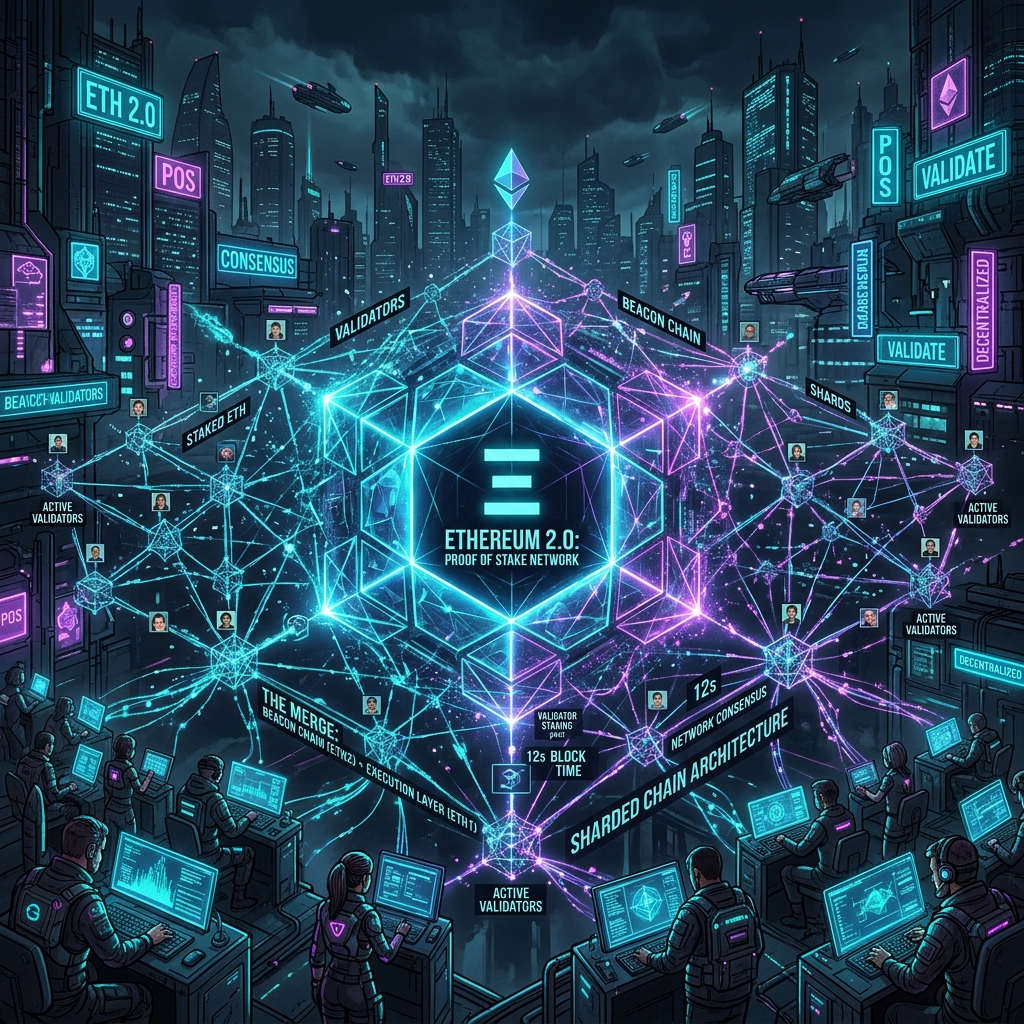
- Prompt: “High-tech visualization of Ethereum Proof of Stake. Glowing 32 ETH blocks locked in transparent digital vaults, connected by laser beams to a central glowing Ethereum diamond, signifying network consensus. Cyberpunk aesthetic, deep blues and purples.”
Section 5: Real-World Use Cases in 2026
Ethereum is not just theoretical; it powers multi-billion dollar sectors today.
Decentralized Finance (DeFi)
DeFi on Ethereum allows users to lend, borrow, and trade assets without banks. Protocols like Uniswap and Aave process billions in volume entirely via code.
Digital Ownership and NFTs
Ethereum NFTs go far beyond digital art. In 2026, NFTs are used for tokenized real estate, supply chain tracking, and digital identity verification.
Decentralized Applications (DApps)
From decentralized social media to transparent prediction markets, DApps provide services that are immune to centralized deplatforming.
Section 6: Legal & Regulatory Landscape
As Ethereum has grown, so has regulatory scrutiny. By 2026, the regulatory framework has matured significantly. While the SEC and other bodies initially debated whether ETH was a security, the transition to PoS and the approval of Spot Ethereum ETFs in major markets firmly established ETH as a highly regulated, institutional-grade digital commodity.
However, regulatory clarity regarding specific DeFi protocols and smart contract taxation remains a complex and evolving jurisdiction-by-jurisdiction issue.
Section 7: Risks & Challenges
No technology is without flaws. Ethereum faces several critical challenges:
- Smart Contract Vulnerabilities: Because code is law, a bug in a smart contract can lead to devastating hacks. Over the years, billions have been lost to exploits in poorly audited code.
- Scalability Limitations: The base layer of Ethereum can only process roughly 15-30 transactions per second. During high demand, this leads to astronomical gas fees.
- State Bloat: The sheer size of the Ethereum blockchain is massive, making it increasingly difficult for average users to run a full node.
Section 8: The Future — The Rollup-Centric Roadmap
To solve the scalability trilemma, Ethereum has pivoted to a Rollup-Centric Roadmap. The base layer (Layer 1) acts as the secure settlement layer, while execution and computation happen on Ethereum Layer 2 Solutions.
Networks like Arbitrum, Optimism, and Base process transactions off-chain, bundle them together, and post the cryptographic proof back to Ethereum. This reduces fees by 99% while inheriting the full security of the mainnet.
Section 9: FAQ — Insights into the World Computer
1. What is Ethereum in simple terms?
Ethereum is a decentralized, open-source blockchain system that features its own cryptocurrency, Ether. It works as a platform for numerous other cryptocurrencies, as well as for the execution of decentralized smart contracts.
2. Is Ethereum the same as Bitcoin?
No. While Bitcoin is primarily a digital currency and store of value, Ethereum is a programmable blockchain designed to run decentralized applications (DApps) and smart contracts. Bitcoin is “Digital Gold,” while Ethereum is “Digital Oil” or the “World Computer.”
3. What are Smart Contracts?
Smart contracts are self-executing contracts with the terms of the agreement directly written into lines of code. They run exactly as programmed without any possibility of downtime, censorship, fraud, or third-party interference.
4. What is the EVM?
The EVM (Ethereum Virtual Machine) is the computation engine for Ethereum that manages the state of the network and executes smart contracts. It acts as a single, global computer that everyone can access but no one can own.
5. Is Ethereum Proof of Stake?
Yes. In September 2022, Ethereum executed “The Merge,” shifting from Proof of Work (PoW) to Proof of Stake (PoS). This transition reduced the network’s energy consumption by more than 99.9% and changed how the network is secured—from mining to staking.
💡 Key Takeaways
- Ethereum is a decentralized “World Computer” designed to execute unstoppable applications.
- Smart contracts automate trust and agreements without intermediaries.
- The network is secured via a highly energy-efficient Proof of Stake consensus mechanism.
- While the base layer focuses on security and decentralization, Layer 2 networks are driving global scalability.
Ready to dive deeper? Continue your journey by exploring the differences in our Ethereum vs Bitcoin Comparison or learn how to secure your assets in our guide to the Best Ethereum Wallets.
Explore further topics: