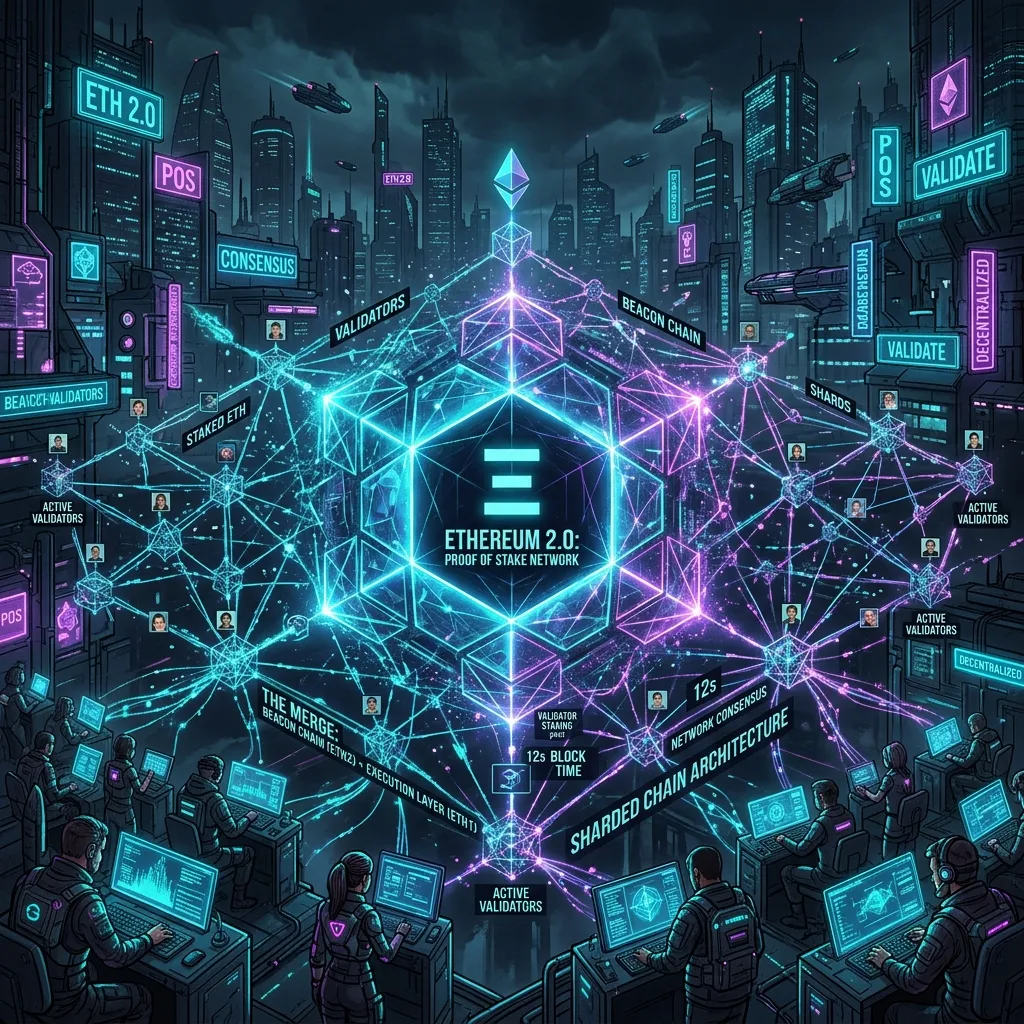
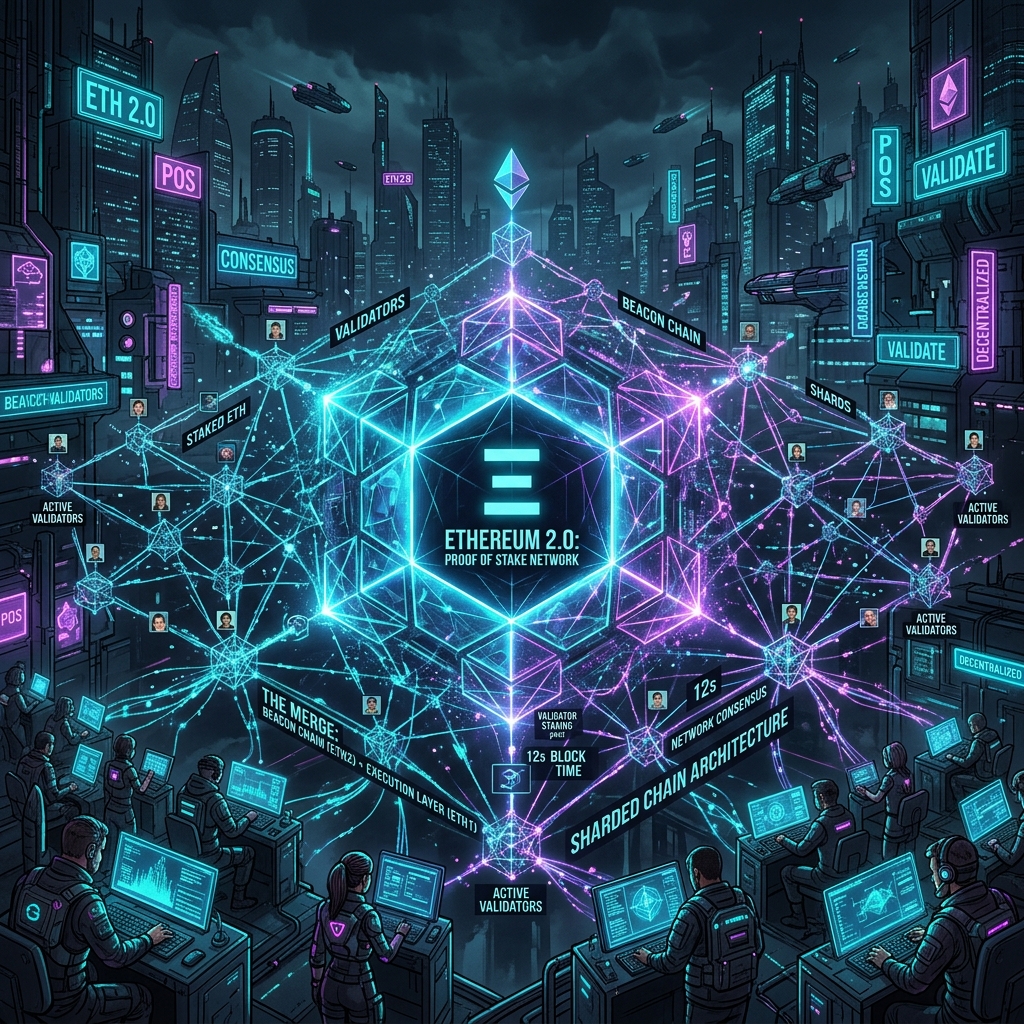
🎯 Introduction: The Greatest Software Upgrade in History
Imagine trying to replace the engine of a commercial jetliner while it is flying across the Atlantic Ocean with millions of passengers on board. That is effectively what the Ethereum core developers achieved with “The Merge” in September 2022.
Originally dubbed “Ethereum 2.0” (a term the Ethereum Foundation has since officially retired in favor of calling it the “consensus layer upgrade”), this massive transition fundamentally changed how the world’s most utilized blockchain operates. By abandoning miners for validators, Ethereum became an ESG-compliant, deflationary, and yield-bearing asset.
In this guide, we explore the mechanics of this upgrade, what Proof of Stake really means, and how Ethereum plans to scale to 100,000 transactions per second (TPS).
Section 1: What Was “Ethereum 2.0”?
Definition
Ethereum Upgrades (Eth2)
Ethereum 2.0 was the colloquial name for a multi-year roadmap designed to make Ethereum more scalable, secure, and sustainable. It fundamentally shifted the network from a Proof-of-Work (PoW) consensus model to Proof-of-Stake (PoS) and laid the groundwork for parallel processing (Sharding).
If you are new to this terminology, we highly recommend reading our foundational guide on Ethereum Explained before diving into the complex mechanics of its upgrade path.
Section 2: The Merge — Killing the Miners
Before September 15, 2022, Ethereum functioned much like Bitcoin. Huge warehouses full of graphic cards (GPUs) consumed massive amounts of electricity to solve cryptographic puzzles and process transactions.
“The Merge” was the event where the original execution layer of Ethereum joined with the new “Beacon Chain” consensus layer. In a single moment, the entire network switched off the miners.
Becoming a Validator
Instead of buying hardware, participants now 'stake' (deposit) 32 ETH into a smart contract to become a network validator.
Proposing Blocks
The protocol randomly selects a validator to propose a new block of transactions.
Attestation
A committee of other validators verifies the block. If valid, it is added to the blockchain.
Rewards & Slashing
Honest validators earn newly minted ETH as yield. Malicious actors have their staked ETH destroyed ('slashed').
You can compare this mechanism directly against Bitcoin’s security model in our Ethereum vs Bitcoin analysis.
Section 3: The Economics of “Ultra Sound Money”
The transition to PoS drastically altered Ethereum’s monetary policy.
Under PoW, the network had to pay miners roughly 13,000 ETH per day to cover their massive electricity bills. Under PoS, security is much cheaper. The issuance dropped by roughly 90% to about 1,600 ETH per day.
When combined with EIP-1559 (an upgrade that burns a portion of Ethereum Gas Fees in every block), Ethereum often burns more ETH than it creates. This makes ETH mathematically deflationary—a concept the community affectionately calls “Ultra Sound Money.”
- Prompt: “A glowing Ethereum logo inside a high-tech digital forge. Flames made of binary code are actively burning away small ETH symbols, while a large, solid, pristine ETH crystal emerges from the center, symbolizing ‘ultra sound money’.”
Section 4: Scaling the Future — “The Surge”
A common misconception is that The Merge made Ethereum faster and cheaper. It did not. The scaling phase of the roadmap is known as The Surge.
The cornerstone of The Surge is Sharding (specifically Danksharding and Proto-Danksharding / EIP-4844). Instead of forcing every node on the network to download and verify every single piece of data (which is slow and expensive), Danksharding introduces “data blobs.”
This allows Ethereum Layer 2 Solutions like Arbitrum and Optimism to post their bundled transactions back to the main Ethereum chain at a fraction of the cost. Through Rollups and Danksharding, Ethereum aims to process upwards of 100,000 transactions per second.
Section 5: Beyond 2026 — The Scourge, Verge, and Purge
Ethereum’s development does not stop with The Surge. Vitalik Buterin has outlined several subsequent phases to perfect the “World Computer”:
- The Scourge: Focuses on censorship resistance and mitigating the risks of Maximum Extractable Value (MEV), ensuring the network remains decentralized at the validator level.
- The Verge: Introduces “Verkle Trees,” allowing users to become network validators without needing massive hard drives to store the entire blockchain history.
- The Purge: Eliminates historical data debt, simplifying the protocol and reducing the hard drive space required to run a node.
Section 6: FAQ — The Roadmap Explained
1. Is Ethereum 2.0 a new coin?
No. Your ETH is the same as it has always been. “Eth2” is simply a name for the software upgrades. Any exchange or person telling you that you need to “swap” your ETH for “ETH2” is likely a scammer.
2. Did Ethereum 2.0 lower gas fees?
The Merge changed the security model, not the capacity of the network. Fees remain high during congestion. However, the roadmap scales Ethereum via Layer 2 solutions, which provide the 99% cost reduction users are looking for.
3. How much energy did The Merge save?
By eliminating the need for massive mining farms, Ethereum reduced its carbon footprint by 99.99%. It is now one of the most environmentally friendly computing networks on Earth.
4. How do I stake my ETH?
If you have 32 ETH, you can run your own validator. If you have less, you can use Liquid Staking services. This allows you to earn roughly 3-5% APY on your ETH while maintaining the ability to sell or use your staked assets in DeFi.
5. What is “The Merge” exactly?
Think of it as switching the engine of a running car. The execution layer (where transactions happen) was merged with the consensus layer (where security happens), effectively turning off the “Proof of Work” engine and turning on the “Proof of Stake” engine without a single second of downtime.
💡 Key Takeaways
- “Ethereum 2.0” is not a new coin; it is a series of structural upgrades.
- The Merge successfully transitioned the network to Proof of Stake, reducing energy consumption by over 99%.
- Staking allows ETH holders to earn native yield, fundamentally changing ETH’s profile as an institutional asset.
- Future scalability relies heavily on Layer 2 Rollups and Danksharding to lower transaction costs for global adoption.
Ready to dive deeper? Now that the foundation is secure, explore the financial revolution built on top of it in our Guide to DeFi on Ethereum, or discover how Smart Contracts make all of this possible.